Introduction
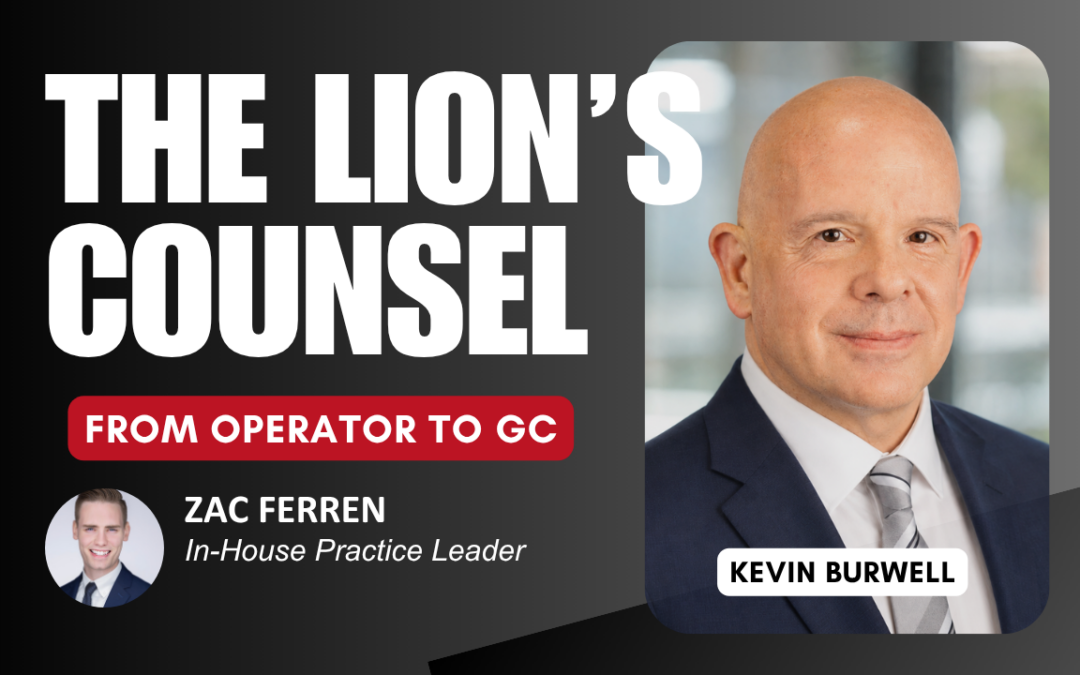
Kevin Burwell did not take the usual road to the general counsel’s chair. Before he was a lawyer, he spent years in operations and economic development: international logistics, foreign trade zone policy, and government affairs. He came to the law commercially grounded and execution-focused, and he has spent the years since building legal, governance, and compliance functions from the ground up inside some of the most operationally complex, multi-jurisdictional environments in industrial manufacturing.
Today Kevin is VP and General Counsel of Kloeckner Metals for the Americas, the roughly $5 billion North American subsidiary of the publicly listed German industrial group Klöckner & Co. He was recruited to establish the company’s first legal, compliance, and internal controls function from scratch across its U.S. and Mexico operations, reporting into a German parent. He is now leading legal integration as Kloeckner moves through a voluntary takeover by Worthington Steel, serving as the bridge between U.S., Mexican, and German legal and governance teams and navigating cross-border deal mechanics that few GCs ever encounter. It is his second first-GC build in a row; before Kloeckner, he stood up the legal function at Knight Material Technologies as it was carved out of Koch Industries and taken private.
In this conversation, Kevin talks about the throughline that ties his whole career together, why most companies get international wrong at first, how he builds a legal team and then gets out of its way, and the three relationships he believes make or break a general counsel.
From Foreign Trade Zones to the Legal Chair
Zac: Would you mind giving an overview of where you started in your career and how you ended up in your position today at Kloeckner?
Kevin: There were a few starts and hurdles along the way. I spent a number of years at the Port of Virginia. Some would consider it non-legal, though there are a lot of attorneys involved in it. I went from running their trade analytics to running the foreign trade zone, and in that role I ended up working with the National Association of Foreign Trade Zones, serving on their board and at the executive level for a number of years. That led into advocacy in D.C. Foreign trade zones are an economic development tool, and there is a lot of legal structure around them, plus cross-border trade and everything that goes with it.
At one point, I was encouraged to come back to Ohio, where I grew up, and I came back at a good time. Shortly after, I was recruited by TimkenSteel. They had just spun off from Timken and needed to build up their trade, customs, and government contract compliance programs, so I worked for the general counsel there. While I was at TimkenSteel, I went back to law school and completed my degree at the University of Akron, sat for the bar, and had the chance not only to spend time in a law firm but also to feel the pain of running my own practice.
Then, at a fortuitous point, I was recruited by Koch Industries out of Kansas to become the first general counsel for a company they were spinning off to private equity, which became Knight Material Technologies. That was a great opportunity to learn what it is like to be that first general counsel and to build up processes and guardrails. In mid-2024, a good friend in the recruiting world called and said, “I’ve got a friend who just put something up, and you’re perfect for it.” Very shortly after, I joined Kloeckner Metals, a $5 billion metals manufacturer with several thousand employees, owned by a German parent, with operations throughout Europe, the U.S., and Mexico. I built the governance, regulatory, and compliance team as the first general counsel for it in North America, and positioned it so that earlier this year, when we entertained a voluntary takeover bid from Worthington Steel out of Columbus, Ohio, we were ready. We have been doing that work since, which is an interesting exercise in combining German law and U.S. law, all while running M&A projects on both the buy and sell side and continuing to build the team in the U.S. and Mexico.
International as a Throughline, Not a Specialty
Zac: Even going back to the Port of Virginia, you have always had this international and global dynamic in your roles. Was that intentional, or something you fell into?
Kevin: There has always been a global interest somewhere in my brain, and it kept building. If you are in the maritime industry, you are involved in cross-border topics by definition, so getting my feet wet there was healthy for me. Foreign trade zones are essential to a lot of cross-border issues, and I had the chance to learn from some very knowledgeable people. It just continued as I moved into companies.
At Knight Material, we worked all over the globe. The company produced corrosion-resistant linings in Ohio and then sent expert brick masons out everywhere, from Saudi Arabia to Papua New Guinea. We had an office in Chile and bought a company in Canada. A job could be in a remote spot in Winnemucca, Nevada, or in the Dominican Republic. Dealing with contracting issues, travel issues, labor and employment, and moving product from one country to another, which Knight Material did extensively, it just becomes part of who you are. Some attorneys lean into what interests them. I did the same, and this is what interested me.
Zac: Working across so many organizations with that international component, what do you think companies get right, or get wrong, when it comes to cross-border operations?
Kevin: What is interesting about that question is that, initially, not many get it right. When you are doing something for the first time, and it may be the only time you ever do it, there is an awkwardness to it. Do I need to read the manual? Do I need special instruction? Do I need someone who has done this before? It does not matter what it is. So when companies move into the international arena, they have the motivation, maybe a customer asked them to source or make something, and they are in a position to figure it out. But a lot of the time they apply what they already know to it. I would not say that getting it wrong at first means it is wrong. It means they are trying to understand and make the best fit.
Here at Kloeckner, I have been fortunate to come in with a broad brush of experience, so it is easier for me to spot those things quickly. That is really the difference-maker in whether a company gets it right. They see a matter in front of them, and they do not recognize that the matter could be a trap, a hurdle they do not know how to clear. Identifying those things early is the critical part.
Building the Function From Scratch
Zac: Coming into Kloeckner, you had to build the legal, compliance, and regulatory functions from scratch. Tell me about that experience.
Kevin: Again, it was a company trying to understand something in front of it that it did not have enough awareness of. They had built up a couple of other functions in the years prior and had some capable people in place, and they had guidance from the parent company in Germany. The parent had just purchased National Material of Mexico for about $340 million, and they told the North American business, in effect, “You have a problem. You have nobody guiding this legally. Look at what we do here in Germany. You need that governance, regulatory, risk, and compliance team.” They worked with a recruiting firm local to Atlanta, and I came in and started asking questions. What are you trying to accomplish? What does the business outlook look like? What are you targeting for the future?
To be candid, right when I started, there was already a sense that something like where we are now, this takeover, might happen. Whether it was a takeover, going public, or a bigger investor, something had to happen for strategic growth, and my job was to put everything in place so we would be ready. The first thing is getting to know the business, which was not difficult for me. I come from a steel background. My dad was a steel hauler for 40 years and drove a truck out of Canton, Ohio. Everybody in your family or your circle worked for a steel mill. So I came in, asked the right questions, got to know the business leaders across the board, and started to identify what the function needed.
If I am going to sit at that strategic level with my peers in the C-suite, I need people doing the work: someone focused on redlining every contract, on getting outside counsel paid, on training people on platforms. Then you put the pieces together and advocate to the other decision-makers. This is what we need. This is what the team should look like: attorneys, legal ops, ethics and compliance. And then you go get good talent.
When I arrived, I had one corporate counsel in Mexico and a paralegal available in the U.S. I found two fantastic associate general counsel to add in the U.S., and added another corporate counsel and a law clerk in Mexico, along with a compliance officer. Each associate GC has a broad brush and can handle anything, but one has a scope on ethics and compliance and one is focused on operations. I also brought in internal controls, because Worthington Steel, the company doing the takeover, is publicly traded in the U.S. Part of my thinking was that we need to be moving toward SOX compliance, which was not something the German parent was prepared for or aware of, so I guided it in that direction.
As I brought these attorneys in, their mandate was simple: go be you, and make an imprint. You are well trained. You know what to do. I am not micromanaging. Go do what needs to be done. And they made an impact. That is how I look at it: what is the business doing, what does the business need, and how do we find really good talent to put into it?
Leading a Cross-Border Team
Zac: With people distributed across their own cities and countries, what have you found works to keep the team cohesive and moving forward?
Kevin: One of the first things I did at Kloeckner was make fairly regular trips down to the offices in Mexico. I spent time with the attorney I have down there and had him introduce me to the firms we use as outside counsel. In that relationship, I deferred to him. You know your jurisdiction, you know your laws, you know this; I do not. Tell me about the culture. In Mexico, it is very family-oriented, so you spend time getting to know the families of the people on your team. I know a lot about his wife and his kids, including a teenage son who competes nationally. Those things matter. It builds a bond, a trust, a way of interacting, and it helps him understand what I am trying to do.
Once we had more of the team in place, we added weekly calls. We start Monday at 10:30 in the morning, which works for everyone. We keep an agenda in OneNote, and anyone can throw in a hot item. It is not about what did you do. It is about what does everybody need to know. That keeps people on track.
Fundamentally, I recognize that they are in charge. They know their business; they know what they are doing. It is not about me telling them what to do. It is about finding ways I can help them. My question from day one is, what do you need? How can you do your job the best way possible? Do you have access to the right people? Do you have flexibility? One example that may sound unusual to folks in the U.S.: based on your level in Mexico, a company-provided vehicle is essential, and what matters is the type of vehicle. Someone hired at a certain status who receives a vehicle of a much lower status is rightly concerned about how that looks to peers and clients, so part of my job was to make sure that was rectified. Paying attention to what actually matters to your people, wherever they sit, is the job.
The Three Relationships That Make or Break a GC
Zac: Beyond the team, what else do you see as critical from that strategic seat? What makes a great GC?
Kevin: A couple of things. One is understanding the CEO. I report to the CEO, and if you do not understand the CEO’s appetite for risk, you are not getting anywhere. It changes from CEO to CEO and from business to business, and sometimes a single CEO changes in the moment. You have to be good at reading them, knowing when to bring something their way and when not to. That is not just about privilege. It is about making sure they understand that when you come to them, this is the time to listen. It is a back-and-forth kind of training, and after you have done it a few times, you develop a cadence that goes along with the trust. Honestly, if a general counsel has lost the trust of their CEO, they should walk out the door, because it does not matter what happens after that. That is the absolute key.
The next critical element is the business unit leaders, and for a general counsel, the number one is the head of HR. It has to be an absolutely regular cadence, and by cadence I do not mean a standing nine o’clock on Wednesday. I mean I walk in the front door and go stand in their office doorway for eight minutes and just say, what is going on, how are things? At Knight Material, I actually got to the office much earlier than I had planned, because our head of HR preferred to be in very early, and that is when I learned about employment matters. I could listen, and if I heard something, I could grab it before it became an issue. That is what I am looking for with HR: the rumblings. Maybe we brought someone in a few months ago and something has evolved in their working location in one of our roughly sixty branches, and the HR business partners are talking about it. It could be an employee we want to bring in from another country, where we need to talk through whether it is a sponsorship situation and what the role looks like. People behave like people. They get upset in the moment, they react, and it is up to us to apply the code of conduct to the situation. I want to get ahead of it. Did somebody say something? Do we need to jump in?
Then there is the CFO, the head of finance. It is critical to understand the guidance they need. They can get head-down in accounting procedures and dollars and cents, but they also want to think strategically. You might be walking through an M&A deal where a topic comes up about a holdback, escrow consideration, or what certain indemnifications mean financially. If you understand what they are trying to do and how they are trying to balance everything, then when you present a risk, or what it could mean in dollars and cents, you are already speaking their language. You reference something you talked about before and say, that is what this means. That constant communication helps you get through to them quickly. They have a lot to consider, so you need to talk to them in terms that shorten your time together and let them make the decision they need to make. CEO, head of HR, and CFO. Those are the critical ones.
Adaptability Over Intelligence
Zac: Is there anything else you think is important for people in your seat, or aspiring to it?
Kevin: I have given this guidance recently. Being the smartest person in the room is great if you want to be able to do everything and accomplish everything. But if you have not learned how to adapt to the tone and tenor of the situation, that intelligence is not going to do you any good. Learning to develop what people call emotional IQ, and being able to reflexively adapt to different people, is what separates you. One business unit leader will approach you one way, and another will approach you a completely different way. If you understand how to adapt to their tone and tenor, you are going to be much more successful, because you are going to be much better received.