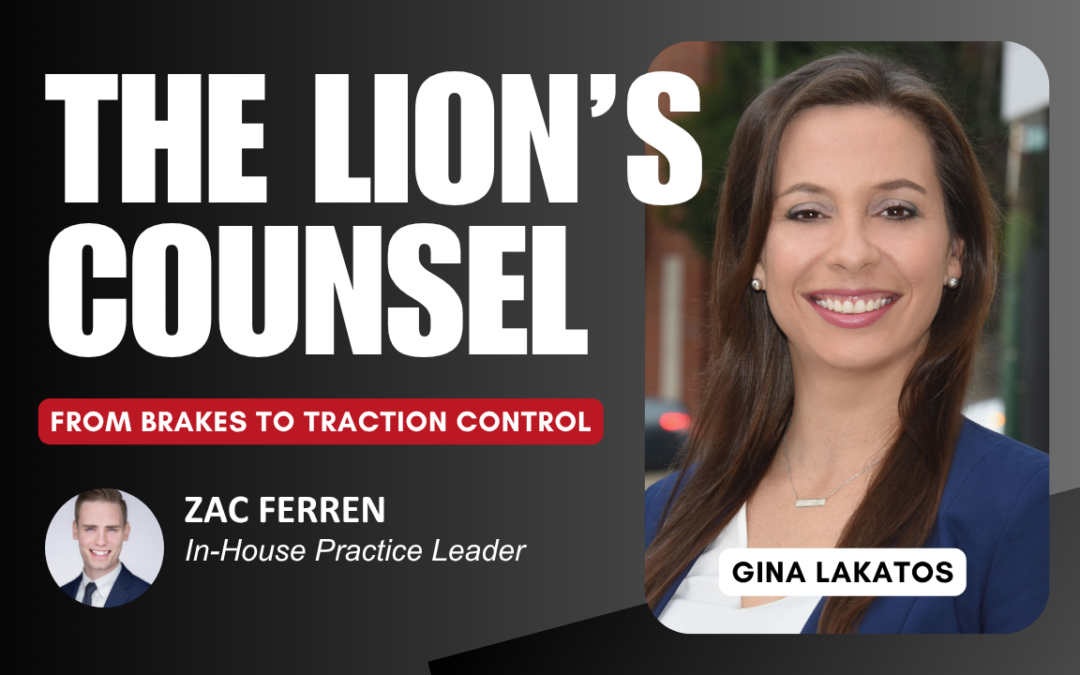
Gina Lakatos has done the hardest version of the in-house job not once but three times: walking in as the first lawyer in the building and constructing a legal function from scratch.
Today, she serves as Senior Vice President, General Counsel, of Lessen, LLC, a technology-enabled property services provider that facilitates maintenance, repair, project management, and other property services utilizing its network of independent service providers. At Lessen, Gina leads the legal and compliance functions, responsible for shaping the company’s legal strategy, establishing robust governance frameworks, and building comprehensive compliance programs that enable and support sustainable business growth. Previously, she served as Vice President, General Counsel, and Corporate Secretary of John B. Sanfilippo & Son, Inc., a publicly traded, family-controlled food manufacturer with multi-site operations and global distribution. There, she replaced a fully outsourced legal model with the company’s first in-house function, while strengthening corporate governance and SEC compliance, leading legal and compliance oversight across operations, and driving M&A from target identification through post-close integration. Before JBSS, she served as VP, General Counsel, and Corporate Secretary of Sears Authorized Hometown Stores during a period of restructuring and operational transformation, and earlier as General Counsel and Chief Operating Officer of Element Health, a corporate wellness and healthcare services company where she built the company’s HIPAA-compliant privacy and data-security programs from the ground up. The first half of her career was spent in private practice as an insurance defense litigator — work she credits with shaping how she thinks about risk, playbooks, and the protective frameworks businesses actually need.
In this conversation, Gina shares her “triage and anthropology” framework for the first 60 days as a first-in GC, why modern legal leadership must evolve from being perceived as the brakes to becoming the traction control of the enterprise,, how to embrace legacy outside counsel while bringing your own bench, and — drawing from a nine-month search she recently navigated herself — what actually moves the needle for senior legal leaders in today’s saturated job market.
A Career in Two Halves
Zac: Gina, I really appreciate you making the time today. Would you mind sharing with our readers a little about your background and how you got to where you’re at today?
Gina: My career has unfolded in two distinct but complementary chapters. During the first, I built a strong foundation as an insurance defense litigator — from medical malpractice to premise and product liability. Even in private practice, many of my clients increasingly sought more than litigation support. They wanted playbooks, compliance programs, and strategy frameworks to reduce risk, establish structure, and create operational alignment – the very things that help an organization maintain traction when the environment gets unpredictable. That demand is what ultimately sparked my transition into the second half of my career: serving as an in-house General Counsel who builds legal functions designed to stabilize growth and enable velocity.
Since moving in-house, I’ve been the first legal executive at each of the three organizations I’ve joined. In each role, I’ve been responsible for building legal, compliance, and at times, HR functions by establishing infrastructure, systems, and operating discipline needed to support growth. My experience spans health and wellness, franchising and retail, and food manufacturing, giving me a broad perspective of how legal can drive operational excellence across complex, highly regulated environments while serving as a control system that keeps the business moving forward with confidence.
Triage and Anthropology: The First 30 – 60 Days
Zac: That’s a lot of “first-in” reps. And not everybody is equipped to be the first legal hire. When you walk into a company as that first lawyer, what are the first 30 to 60 days actually about? How do you prioritize where you spend your time?
Gina: The first 30 to 60 days are focused on two priorities: triage and organizational anthropology. Triage, because you quickly learn which issues present real enterprise risk and which are legacy “smoke machines” that have been left unchecked for years. Anthropology, because you’re studying the culture, the power dynamics, the unwritten rules that explain how the organization truly operates – the conditions of the “road” you’re about to help the business navigate. It’s a comprehensive assessment of the business, not just the legal landscape.
My early priorities are simple. First, understand how the business actually generates revenue and creates value. Second, identify where risk is quietly compounding beneath the surface. Third, build trust with the people who need to see legal as a stabilizing force that helps them move faster. In these first months, it’s less about building a formal legal department and more about assessing the operational dynamics of the business that no one has documented but everyone follows.
Zac: What kinds of common mistakes do first-time legal leaders make trying to establish credibility? What landmines are out there when coming into an organization?
Gina: By far the biggest mistake any legal leader can make coming into an organization is trying to prove they’re the smartest person in the room. Not only does no one want that person in a meeting, but it also makes it harder to get an accurate read on the business – you can’t provide traction if you don’t understand the terrain. Credibility is earned by listening, not lecturing; by solving a real business problem, not drafting a 47-page policy that no one asked for. The role is to be a strategic stabilizer, not a corporate hall monitor.
Another common misstep is failing to operate at the speed of business. We lawyers love a deep-dive analysis, but a full legal analysis and a business transaction move entirely different timelines. Delivering timely, practical guidance is essential for any new in-house counsel. The goal is to enable momentum, not slow it down.
Zac: That’s a real mindset shift. Even when we recruit law-firm lawyers into in-house roles, the move from billing your time to driving the business is one of the hardest transitions. Where do you consistently find the fastest wins when you step into a new organization?
Gina: The fastest wins are almost always hiding in plain sight. Legacy contracts no one has reviewed in years,auto-renewals quietly draining the budget, and processes that require 12 emails, three approvals, and a séance.
My favorite early wins are anything that increases operational speed and restores traction. If you can shave days off a sales cycle or remove friction from a workflow, you shift the perception of legal immediately. You are now the strategic enabler who has a seat at the table from the outset because you help the organization move faster with confidence.
Traction Control, Not Brakes
Zac: Some companies can see legal as a necessary cost center, but your approach is much more aligned with growth and revenue enablement. How do you shift the perception of legal internally from a cost center to a business enabler?
Gina: Modern in-house teams have moved well beyond the outdated perception of being the department of “no”. It takes an extreme situation for legal to truly hit the brakes because the real value of a seasoned General Counsel is knowing how to keep the business moving forward with control. So first, shift the mindset: stop defaulting to no. Start with yes, and then define the path to get there responsibly.
Our role is to provide options that enable the business to grow. Legal is not the organization’s brakes; it’s the traction control. We help the company go faster, with stability and confidence, without spinning out. Once people realize you’re there to help them win, the perception changes almost instantly.
Zac: How can legal directly reduce costs, improve EBITDA, or drive revenue in a measurable way?
Gina:Legal is a meaningful EBITDA lever. Not because it “avoids risk”, but because it reduces costs, accelerates revenue, and improves margin quality.
The most immediate impact is optimizing outside legal spend. Understand your network and the law firms available to you. By aligning the risk profile of each matter with the right firm, setting clear billing expectations, and enforcing disciplined guidelines, you can materially reduce legal expenses without compromising outcomes.
The second, equally powerful lever is reducing claims and litigation exposure. Programs, protocols, and early resolution strategies lower both the frequency and severity of claims. Fewer active claims translate directly into lower reserves for the finance, reduced external spend, and a measurable lift to EBITDA.
Legal also accelerates revenue by removing friction from the contracting process. For example, implementing a streamlined commercial playbook and automated workflows can take days out of the sales cycle – increasing speed while maintaining control. When contracts move from a 14‑day turnaround to a 3‑day turnaround, revenue is recognized faster, cash flow improves, and the business closes more deals per quarter.
Finally, legal improves margin quality by strengthening commercial terms. Introducing automatic price escalators, tightening indemnities, or negotiating more favorable payment terms can materially improve gross margin without increasing volume. A single contract renegotiation that shifts payment terms from net‑60 to net‑30, or adds a 3% annual price increase, has a direct and quantifiable impact on EBITDA.
Embrace the Old to Empower the New
Zac: When you come in as a first-time legal hire, are you typically bringing your own outside counsel, working with whomever the company already uses, or doing some combination?
Gina:During that 30- to 60-day assessment period, you’re triaging your outside counsel with the same discipline you apply to the rest of the organization. Every company has its legacy players as well as its newer players brought in to break up groupthink and produce innovation. These two groups often operate with different assumptions and approaches, and it’s important to understand the value that each brings.
You have to embrace the old to empower the new. You need the historical legal bench players because they carry the institutional memory that helps you understand where the business has lost traction in the past and where it’s most vulnerable today. They can tell you where the business has been, the issues that surface repeatedly, and where legal has been most heavily relied on. That history is essential for understanding the company’s operating environment and for identifying where you can make an immediate impact.
At the same time, you also have trusted external partners, where the relationship is built on years of trust, navigating issues across multiple organizations. They know how you operate, they understand your expectations, and they will be candid enough to tell you how things really are which helps you navigate decisions quickly. I don’t view this as an either‑or choice. Just as you would with other essential organizational functions, you want a blend: the institutional knowledge of legacy counsel combined with the fresh perspective and efficiency of innovative partners. My approach is to integrate both. I honor the history while elevating the function with new thinking and modern execution.
Building Legal Ops Without Anyone Feeling It
Zac: Legal ops is a big part of what you build when you’re the first attorney in. Having done that multiple times, what does good legal operations actually look like in a growing company, especially early on?
Gina: Early legal operations is the art of building order out of chaos — quietly and without disrupting the business. The organization shouldn’t feel turbulence, and frankly, most employees won’t know what “ legal ops” is. Thus, this responsibility sits squarely with legal.
First, let’s define “legal ops.” Legal operations is the business infrastructure that brings clarity, consistency, and speed to how legal supports the company. It aligns people, processes, technology, and data so the legal team can operate like a high‑performing business unit, not a reactive service desk. In other words, it is the systems that give the business grip when everything around it is moving and at times, unpredictably.
So what does “good” look like? First, contracts must be findable. Many organizations don’t know where agreements live, who signed them, or when they expire. Establishing visibility and control is foundational. Second, processes must be repeatable. Sales, Ops, Finance, Procurement – nobody wants to go through legal training. They want clarity. Make your processes a simple 1-2-3 workflow for routine ideas like NDAs. Simplicity drives adoption; repeatability creates traction.
Second, employees also need to know where to go for what. When you’re the only legal person in the building, that answer is straightforward. As legal teams grow, clear role definition becomes essential for effective triage and efficient support. Nothing in the legal department should require a treasure map to locate.
Third, when someone engages with legal, it should feel like a normal conversation. Listen to what they are trying to accomplish and succinctly explain the rules of the road and the “traction control” that will be used along the way to achieve the goal. Meeting people in their own business language builds trust and speeds decision-making. If you can create clarity, consistency, and speed — congratulations, you’ve built good legal operations that function like traction control: always on, always stabilizing, and rarely noticed because the ride is so smooth.
Zac: And how do you decide what to build in-house versus outsource when you’re starting from zero?
Gina:The rule is straightforward: if the work is strategic, recurring, and core to the business, it belongs in-house. These are issues you will face repeatedly, and the organization needs internal expertise. If you don’t have the depth, develop it by getting the training, studying the landscape, and building the capability. Owning these competencies is essential to being an effective partner to the business and enabling momentum.
Conversely, if it’s specialized, sporadic, or just soul-crushingly tedious that it offers little strategic value, outsource it. These are tasks that are a once-every-five-years manual exercise or require niche expertise. Your time as an in-house business partner is better spent as a high-impact business partner. In-house counsel should always be focused on judgment, speed, and strategic enablement.
Winning the Legal Job Market in 2026
Zac: You’ve spent the last nine months navigating today’s legal job market yourself, which makes you uniquely qualified to comment on it. What are you seeing that candidates may not fully understand yet?
Gina:There are almost two million professionals in transition right now. The market is saturated with talent at every level – from new attorneys to seasoned in-house leaders with decades of experience.
In an environment this competitive, the differentiator is not your resume; it’s your ability to stand out with clarity and purpose.
First: demonstrate impact, not just experience. Employers may say “tell us about your experience,” but what they’re actually asking is “show us your impact.” Where do you create value? What do you change, improve, or accelerate? How do you influence cost, EBITDA, revenue, or operational speed? You must be able to articulate succinctly how you’re going to affect their numbers, their growth, their costs, and their risk profile. Impact is the currency that separates you from the crowd.
Second: the bar for executive communication has never been higher. You need to clearly articulate your leadership philosophy and the business problems you’re uniquely equipped to solve. This requires precision, confidence, and the ability to translate legal expertise into business outcomes. Show your impact, not just your experience — and communicate with the presence of the executive you are.
Zac: For senior leaders looking for their next role, what actually moves the needle in finding the right opportunity?
Gina: Start by articulating what you’re moving toward, not what you’re leaving behind. This period should feel intentional and forward-looking. Whether you’re in transition, anticipating a change, or simply open to the next right opportunity — define the future you want that is confident, optimistic, and energizing. That’s the presence you want to bring into every conversation.
Anchor your story to problems you are uniquely positioned to solve. Not every lawyer brings the same strengths. Some are operations-driven, some are regulatory experts, some are builders who thrive in ambiguity. Be able to communicate the specific value you create and the environments where you deliver your best work.
Above all else, lead with confidence and optimism. The world has been operating in a state of constant disruption for years. Since the pandemic, the “new normal” has become a moving target. Your own circumstances may be evolving as well: your family is growing, the business is shifting, or a desire for new challenges. Whatever the reason, the most compelling posture is one rooted in confidence and optimism. This is your move. This is your story. Articulate it with clarity, optimism, and conviction.
The Steward of Trust
Zac: Any closing thoughts you want to leave with our readers?
Gina: At the end of the day, the evolution from brakes to traction control isn’t just a clever metaphor — it’s the new mandate for modern legal leadership. Businesses don’t need someone riding the brake pedal; they need someone who can keep them accelerating with confidence, stability, and strategic discipline as they navigate a world defined by uncertainty.
If legal once had a reputation for slowing things down, this new model flips the script. We’re here to enable velocity, not manage inertia. We’re here to build traction, not tension. And when we do it well, the organizations that truly understand strategic value won’t just bring us into the conversation — they’ll question how they ever ran the business without our guidance.
Because in this new era of legal leadership, we’re not the brakes. We’re the traction control — and the road ahead is wide open.