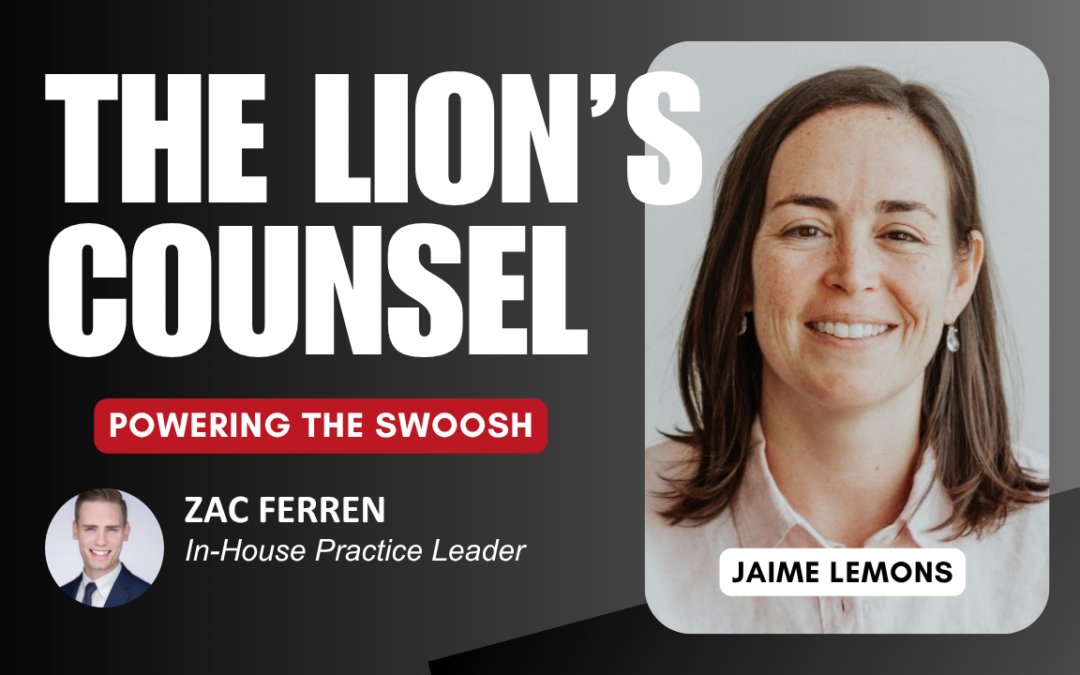
Over nearly two decades at Nike, Jaime Lemons built an incredibly unique legal career. She joined as an individual contributor trademark attorney and rose to Vice President – first leading the global teams responsible for protecting Nike’s trademarks, designs, and copyrights, then taking on one of the most complex mandates in the company: leading Nike’s worldwide Privacy, Cybersecurity, and AI regulatory strategy. A trusted advisor to Nike’s Board of Directors and C-suite, she guided enterprise risk, compliance, and governance decisions with global reach. During her tenure, she oversaw 80+ professionals spanning multiple countries and time zones and orchestrated a network of more than 150 outside law firms.
Before Nike, Jaime practiced at King & Spalding in New York, where she managed global trademark, copyright, and domain portfolios for Fortune 100 companies, and later served as in-house attorney at Yum! Brands, overseeing the global intellectual property portfolios for KFC, Taco Bell, and Pizza Hut. She holds a BA in History from Cornell University and a JD from the University of North Carolina at Chapel Hill. As a leader, she is known for the empathy, calm, and pragmatism she brings to her teams, cultivating high-performing and inclusive cultures at every level.
In this edition of The Lion’s Counsel, Jaime shares how she navigated the leap from individual contributor to senior executive, why the easiest answer in the world for an attorney should never be your starting point, what she learned about communicating with a Fortune 100 board, how she built and managed a global outside counsel network, and what made Nike’s legal department culture unlike any other.
The Career Arc: From Big Law to the Swoosh
Zac: Tell us about your career path and how you ended up spending 17 years at Nike.
Jaime: I started my legal career at King & Spalding in New York, which was an excellent training ground. One reason I chose the firm was its support for first year associates rotating through multiple practice areas. Having the ability to experiment that first year helped me make an informed decision on my future area of focus. From my very first project with the Intellectual Property group, I was hooked. I loved the work and the people and that’s the team I ended up joining.
After several years with the firm, I began to feel a pull towards going in-house. That instinct was confirmed when I was seconded to a client and got firsthand exposure to the in-house environment. Focusing on one company, going deep on their strategy, tailoring my advice to their specific needs was a different kind of practice that appealed to me.
I went in-house to Yum! Brands where I managed their global IP portfolio and led my first team. I wasn’t looking to leave, but then I got the call from Nike — which had been my dream company. As I was preparing for the role and packing my bags, I found a journal from the 7th grade where I had sketched Nike Air Max shoes and written about my excitement for the product. So the roots ran deep.
At Nike, I started as a trademark attorney and took on roles of increasing responsibility, eventually leading the trademark, copyright, and design patent teams globally. After more than a decade in that work, I was offered a fundamentally different challenge: leading Nike’s global privacy, ethics, and compliance program. Having spent my entire career in IP, this was a significant pivot – a much larger team, a completely different area of law, and a deep connection to new areas of the business, including our technology team. I welcomed it.
From Individual Contributor to Leading a Large, Geographically Distributed Team
Zac: You went from individual contributor to eventually leading a team of about 80 people. What was that transition like?
Jaime: It happened in stages but my focus at each transition point was consistent: how could I best support my team and how could the team best understand and serve the business’s goals. I am fortunate to have a cohort of trusted advisors who were great sounding boards along the way.
While I loved the direct impact as an individual contributor, I discovered that coaching and mentoring people was extremely rewarding. Sharing what I’d learned and helping others build confidence and solve problems was energizing. It’s also meaningful to have the opportunity to build the culture of a team and work together to define our mission and vision, set priorities, and celebrate when we achieve them.
Ultimately, leading allowed me to have an impact on people, not just the work. Looking back, the most meaningful moments at Nike were the ones where I had the chance to positively impact someone’s day. And I believe deeply that if you build high-performing, collaborative teams, business results will follow.
Mentorship and Talent Development at Scale
Zac: When you moved to leading that much larger global team, how did you approach mentorship and talent development at that scale?
Jaime: When I transitioned to lead the Privacy, Ethics, & Compliance team, my instinct was to meet with every person individually. I quickly learned that wasn’t feasible at that scale. So I had to shift my approach. My job was to invest deeply in my direct reports and make them multipliers so that the culture, the message, and the goals we set as a leadership team could be carried authentically through the organization.
That meant getting sharp on the fundamentals first. My leadership team and I co-created our strategy, aligned on what we wanted the culture to feel like, and then communicated it thoughtfully and consistently to the broader team. At that scale, clarity isn’t nice to have, it’s everything.
I also knew that accessibility mattered. If I couldn’t meet with every person, I could make sure there was always time on my calendar for anyone who had an idea to share or just wanted to connect. I held weekly open office hours – one week early in my morning, the next week late in my afternoon. People could stop by in person or hop on Zoom so everyone across time zones had a window that worked for them.
Legal as a Business Enabler
Zac: From your experience as both an individual contributor and a leader, what have you seen as best practices for making legal a business enabler rather than a business blocker?
Jaime: The easiest word in a lawyer’s vocabulary is “no.” I made it a point, and an expectation of my teams, that we never led with it. Your job in-house isn’t to present a litany of everything that could go wrong. It’s to distill the noise into what actually matters, give the business clarity on the real risks, and then work alongside them to find the path that balances risk with opportunity. When the business knows you’re trying to get to “yes” responsibly, that’s when they start pulling you into the room.
Building the Brand for Your Legal Team
Zac: Did you notice a difference over time as you built that reputation, getting brought into conversations earlier, building better relationships with the business?
Jaime: Absolutely. With each team I led, there was a clear throughline in how we operated — we’d start by being diligent about understanding what the business was trying to achieve. Over time, that built the kind of trust where people genuinely wanted us in the room. Not because they had to loop in legal, but because they saw us as teammates who would help them get where they needed to go. I’m proud of the fact that every team I led earned that reputation.
Communicating with the Board and C-Suite
Zac: You were presenting to Nike’s Board of Directors and C-suite regularly. What did you learn about communicating at that level?
Jaime: When I first presented to the board, I thought providing very detailed information and analysis would be most helpful. I quickly learned otherwise. Board members are managing an extraordinary range of complex issues. They need the bottom line like no other audience.
They’re incredibly sophisticated people and, to be of the most help to them, you don’t tell them everything you want to tell them. You tell them what they need to know. There’s a real discipline in that. You have to strip away the detail you are proud of to get to what actually drives a decision.
I worked to sharpen that skill with every presentation and the results were clear. Less detail, paradoxically, led to better understanding. The Board could engage more quickly and give us the feedback we needed to move forward.
Managing a Global Outside Counsel Network
Zac: You managed a massive global network of over 150 outside counsel relationships. What did you learn about getting real value out of those relationships?
Jaime: We were relentless in curating our outside counsel network. Not every firm is right for every matter. There are excellent generalists and there are specialists you need for specific, high-stakes work. Our goal was always to match the work with the right partner and we revisited those matches constantly.
We also invested heavily in making the relationship work once we selected a firm. We gave our outside counsel specific frameworks for how to communicate with us – including how we defined risk levels – so that when advice came back, it was already in our language and calibrated to our risk tolerance. That saved enormous time on both sides and made the advice immediately actionable.
And we made the relationship genuinely reciprocal. We’d conduct annual reviews with key firms to give them honest, actionable feedback. One year, we brought our top 25 global counsel to the Nike campus. We took them on a tour of campus, had them meet with our General Counsel, and ran workshops on how to work together most effectively. We shared Nike’s strategic priorities and what was on the horizon, so they could anticipate our needs rather than just react to them.
Zac: What’s the biggest mistake you see companies make when it comes to structuring and managing their outside counsel?
Jaime: The biggest one is silence. If you’re not giving your outside counsel regular, clear feedback on what’s working and where there is room to improve – you’re leaving your partners in the dark. Even when things get busy, that check-in is worth protecting. The return on investment compounds over time.
The second is ambiguity on the front end. If you send a broad request with no guidance on format, scope, or depth, you shouldn’t be surprised when you receive a long legal memo in return instead of the few bullet points you had hoped for but never communicated. Being really specific about what you need up front will help outside law firms meet your expectations and more effectively manage your costs.
What Made Nike’s Legal Culture Special
Zac: What about Nike’s legal department culture did you find really special?
Jaime: The receptivity to thinking outside your lane. While the legal department had specialized areas, that never prevented attorneys from taking on stretches or projects that didn’t fall in their practice area. Everyone was encouraged to think enterprise-wide on a daily basis.
Some of my most formative experiences came from being able to stretch into cross-functional leadership roles early in my career. Those opportunities built a kind of confidence you can’t get in any other way: the belief that whatever lands on your desk, you have the judgment, the business sense, and the instincts to work through it.
Navigating the Tension Between Innovation and Privacy
Zac: When it came to navigating the tension between the business pushing the envelope on innovation and your mandate to protect the brand, how did you approach that?
Jaime: It always started with remaining tethered to Nike’s values. When the business wanted to explore something risky, my first instinct wasn’t to assess the legal exposure – it was to ask whether the idea aligned with who Nike is. If it did, my job was to find a way to make it work and manage risk along the way. If it didn’t, that was the conversation to have – and grounding it in values rather than legal technicalities made it a conversation the business could respect. The company’s values gave me a compass to help guide every situation, no matter how novel.
Looking Back on 17 Years at Nike
Zac: As you reflect on your 17 years at Nike, what are you most proud of?
Jaime: What I’m most proud of isn’t a single accomplishment; it’s the relationships. Everything I was able to accomplish at Nike was due to the deep relationships I developed across the business -whether in product, tech, or marketing – around the world. The work itself spans a range I never could have predicted: protecting the iconic look of the Chuck Taylor All Star shoe across multiple jurisdictions, building a privacy maturity framework that gave the Board clear metrics to track our progress, leading cross-functional teams to prepare for massive global sports moments. Those are very different challenges, but the throughline is the same — none of them happened without deep collaboration and trust across teams.
That’s what I’m most excited to bring to my next chapter. Not just the experience, but the way I work.
Connect with Jaime Lemons
To learn more about Jaime’s work or connect with her directly, visit her LinkedIn profile.