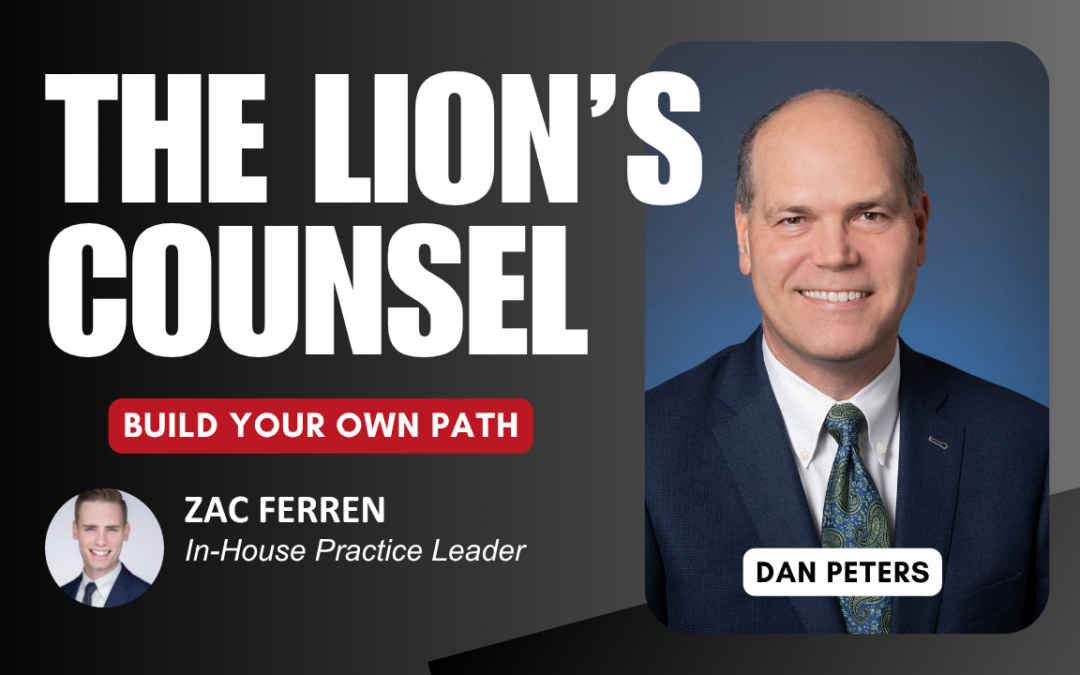
Dan Peters has been a healthcare lawyer for essentially his entire thirty-plus-year career, and he has spent nearly all of it in Kansas. He studied economics and finance at Washburn University before earning his JD at the University of Denver’s Sturm College of Law — a business foundation that shows up in how he talks about the job today. He began at a small firm, Holbrook & Osborn, doing exclusively healthcare work for Kansas and Missouri health care providers, hospitals, physician groups, and long-term care organizations. In 1999 he moved to Husch Blackwell — then Husch Eppenberger — which was building out its healthcare practice in Kansas City.
One of the first matters he touched at Husch was a merger between two physician practices. That transaction created Kansas City Cancer Center, for years the largest integrated oncology provider in the region, which eventually merged into what is now the strongest cancer program in the Midwest, The University of Kansas Cancer Center. When the deal closed, Dan sat down with the CEO of The University of Kansas Hospital. The health system had never employed an in-house lawyer, and Dan became its first.
Fifteen years later, Dan is SVP and General Counsel at The University of Kansas Health System, where he oversees roughly eleven attorneys and a total team of about 100 people spanning legal, corporate governance, risk management, regulatory compliance, insurance and claims, privacy and HIPAA, and clinical research. He also oversees two captive insurance companies.
We talked about building a department, how he decides what stays inside and what goes to outside counsel, what he probes for when a law firm attorney says they want to come in-house, and why the thing that still gets him out of bed has nothing to do with the law.
A Career Built One Natural Step at a Time
Zac: Dan, I appreciate you coming on today. Tell me a little about your background and how you got to where you’re at today as General Counsel at The University of Kansas Health System.
Dan: I’ve been in Kansas most of my life. I went to law school in Denver and I’ve practiced as a healthcare lawyer for pretty much my whole thirty-plus-year career. It’s been a natural progression of taking care of different types of healthcare clients, evolving over the years and decades, increasingly growing into different positions. I’ve only had a couple of different positions, but each of them seemed to progress naturally into the next role. I’ve been really fortunate to have them be natural progressions — personal growth and professional growth with great mentors willing to help me over the years.
Zac: You took the traditional path of going from a law firm to in-house. You’ve done it personally and you’ve talked to a lot of people over your career. How do you see that route into an in-house role?
Dan: I might be a little non-traditional. I think there is a belief that you can’t go from a small firm and build skills and experience and then be able to move up to a major firm and be successful — that there’s only one direction. Similarly, I think some times there is a perception that without going to a top 10 law school, long term options are limited. While the University of Denver is a great school with really great resources, it is not a top 10 school, it has served me well and I just don’t think it is true that there is only one path to success.
Once you’re done with school, it’s certainly possible to create your own path. There are opportunities for the rails to come off, but there are also opportunities to grow into bigger positions and stronger positions. That’s what I’ve done over the course of a couple of different roles.
Zac: What did you do along the way to create that path?
Dan: I was a little fortunate in every spot I’ve been. Starting out in a small firm doing exclusively healthcare law, a lot of my clients were smaller healthcare providers, so I was doing the primary work. Even though at the time it didn’t feel like sophisticated healthcare work, it was hands-on and a very broad base of health care work, because there was not a specialist in my firm for every little nuance of the law. I was doing all the work and communicating with clients directly — great work for both urban and rural Kansas and Missouri providers, for large hospitals, rural hospitals, specialty physicians, and long-term care and regulatory work.
That offered an opportunity to springboard to Husch Blackwell, which at the time I moved there was trying to grow its healthcare practice in Kansas City. I got connected with some great mentors and leaders of the firm who, as a young lawyer, took me under their wing. They gave me opportunities and helped me grow in supporting their clients, and then to build clients of my own.
The Merger That Became a Job Description
Zac: How did that lead to the GC role at the health system?
Dan: It’s an interesting progression, and I get the question in my present role — well, how did you get that role?
The very first client I helped one of my partners with when I joined Husch — at the time, Husch Eppenberger — was a physician practice. Two physician practices were trying to merge together, and somebody asked if I could help with that transaction. I did help successfully merge those two practices together, and that became Kansas City Cancer Center, which evolved into the largest oncology provider in Kansas City for a number of years. That physician group eventually merged into the University of Kansas Cancer Center and made what is now the pre-eminent cancer provider in the region.
At the end of that transaction, I sat down and met with the CEO of The University of Kansas Hospital (now health system). He asked me what I wanted to do. I told him I wanted to join The University of Kansas Hospital and that I wanted the ability to make an impact on the organization. We both knew The University of Kansas Hospital had never had an in-house general counsel before so we knew it would be a leap of faith to trust each other in how this was going to work. He asked me to write a job description and start working and build an internal legal function. So we did that. That’s how I started working at The University of Kansas Hospital in 2011.
From One Lawyer to an Overall Team of 100
Zac: That’s incredible. So you start as the first attorney at The University of Kansas Health System; now tell me about that fifteen-year journey and what you’ve built.
Dan: It’s interesting, because writing a job description was not just that — it’s what’s the business plan to provide legal and related support to the organization? What can we reasonably do inside, and how do we build trust among leaders within the organization?
We had great partners with Polsinelli as outside counsel, and they’ve been such a great resource over the years. Not just helping our organization with legal needs, but frankly helping me, being a great partner and helping us grow that team. Being patient when I’m doing stuff myself, and also there when we need them to help. It took a little while to decide where to start making investments in our own department, growing things internally and creating expertise within the hospital and within the health system to do things ourselves — complemented by specialists and experts outside.
Zac: What does the health system legal team look like today, as far as size and number of attorneys? You started solo. Where are you now?
Dan: At the time I started, there were no official in-house lawyers. We did have one lawyer who was a claims manager and helped with risk management, and that person came underneath me.
Today I have around eleven lawyers in different areas. I supervise both the legal department and some other quasi-legal or related legal areas — risk management, regulatory compliance, insurance and claims. We have two captive insurance companies now. All litigation, compliance and privacy, HIPAA, some clinical research areas. A lot of different areas. All in all, about eleven lawyers give or take at any given time, and a total of about 100 total employees, including the compliance team, the HIPAA team, and our risk and regulatory folks.
Why In-House?
Zac: What’s different about being an in-house lawyer — and what do you enjoy about it?
Dan: One of the nuanced differences between in-house lawyers and our law firm friends is that an inherent component of an in-house role — and in particular a GC or chief legal officer — is that yes, we have to be a lawyer, but an important part of that is being a risk analyzer and a risk manager. We’re complementing legal advice with the goals and needs and expectations of our client.
That’s not to say the lawyers we use at law firms don’t understand or appreciate risk decisions. But they should be looking to us for decision-making. And ultimately our decision making is about the outcomes our organization is trying to achieve.
More than anything, it’s being so close to the reasons that we provide legal advice. What are the goals we’re trying to accomplish? At The University of Kansas Health System, everything we do is about the patient. So when we are making decisions, whether it is in the legal department or any other area of our organization, that is the focus. That’s what helps us with how to provide the best advice. Being really close to the front line of what we’re trying to do.
What He Explores in an Interview
Zac: You’ve built this team up to eleven attorneys. When you’re interviewing — especially someone coming from a firm into in-house — what motivators are you looking for? And what unrealistic expectations do people sometimes bring?
Dan: One of the things I always want to explore when we’re trying to add a role or replace a role is what the expectations are of the lawyer we’re interviewing. Maybe it’s a lawyer already in an in-house position who wants to move — moving positions inside of healthcare, or changing industries. Or alternatively, someone coming from a law firm without any prior in-house experience.
I really do want to know: what are you looking for? What change in your work style makes you feel like this transition to an in-house role is right? What do you expect to be different, and what do you expect to be the same?
A lot of times there are really great answers to that. I love this industry, and I really want to be closer to the things that happen in these organizations. Once in a while I’ll hear the opposite. I’m worn out with my firm, and I’m hoping to have better balance. Sometimes that might be the case — but it doesn’t necessarily mean you’ll be working less. Maybe it’s sometimes more predictable. Again, I just like to explore what motivates people to want to make a change.
What Stays Inside, What Goes Out
Zac: How do you decide what you keep in-house versus what goes to outside counsel?
Dan: Often it’s a combination of capacity, capability, and sometimes repetition — and how specially nuanced the work is.
Sometimes it will be completely outsourcing a full task. I need somebody to own a transaction, or file a patent, or handle a regulatory filing, where I need an owner to take ownership of a project. Other times, I’m going to own a project inside, but I need high-level specialists in four different areas — I need multiple people involved to support a project we’re going to do.
And a lot of times it’s simply that an incident or an event won’t come up with enough frequency for us to have a full-time person doing it, but it needs somebody experienced in that particular area. Healthcare in particular is heavily, heavily regulated, so a lot of what we do really requires depth in a specialty area.
What Makes a Great In-House Attorney
Zac: What do you personally think makes a great in-house attorney?
Dan: The ability to think beyond just what the legal question is that we’re trying to resolve. Identifying the legal nuance matters — but how does that affect decision-making?
Most of the time, people are not looking to us if all we’re going to say is yes or no, you can do this deal or you can’t do this piece. The questions are never that simple. So we have to be able to move beyond does the statute say yes or no, and instead ask how that impacts our organization’s decision-making, and interpret where we’re headed, so we can give a good mix of legal advice that impacts business advice.
Being intuitive. Having high levels of emotional intelligence about how we’re able to effectively influence the organization. Sometimes, when things are really complicated, people won’t sit around and listen to us do a thirty-minute explanation about how complicated things are. They just want an answer. So being willing to control how much we talk, so that people will listen when we really, really need them to listen. That’s something that’s kind of hard to get used to.
The Value of the Circle
Zac: You’re part of multiple groups. I know you’re part of a general counsel group here in Kansas City that gets together quarterly, and you moderate a group of other academic health system GCs. What kind of impact have those had on you personally and professionally?
Dan: I actually think those are some of the best investments of time I spend during the course of a week or a month, where we have the opportunity to both share learnings and learn from other people in the same position I am in at other great places.
The great thing about the group of friends I’ve developed in these roles at other large AMCs (Academic Medical Centers) around the country is that they’re experiencing the same things that I am and my organization is. Being able to both offer advice and receive advice from people who have been down the path of our challenges and our successes — we’re all teaching and learning organizations. Having leaders of legal departments and healthcare lawyers who’ve been there matters. It’s frankly a pretty small circle of people doing this at the highest level of the biggest academic centers around the country, and you run into these people at meetings we speak at and places we interact. It’s great having that circle of friends to fall back on, to get advice from, and to be able to help out when people are in need of support.
I’d add that I’ve appreciated being able to interact with you, Zac, and with your team, and to learn more about our Kansas City legal community. That’s been an additional tool for my own growth and my ability to interact with colleagues and be introduced to peers. Over the years, being able to continue to grow in the Kansas City community has been important as well.
Why the Lights Stay On
Zac: For you personally, what energizes you to go to work every day?
Dan:In general, I just like what I do and I like what my organization does. My colleagues within the health system look at the wide variety of legal issues that come at us every day and are amazed at how our team keeps up with everything. But that is also what is refreshing — something new happens literally every day.
But places like The University of Kansas Health System, we save people’s lives. We change people’s lives and perform miracles every day. Even though I don’t put my hands on patients, I know I have a major impact on our ability to continue to perform miracles every day.
Sometimes it’s leaving the hospital in the winter at seven o’clock, and it’s dark, and you turn around, and all the lights are still on, and all the beds are still full, and nurses are going everywhere, and pharmacists are going everywhere, and you know that it never stops. The mission we have of trying to impact people’s lives in those ways — that’s what continues to motivate me to try to be great at what I do.