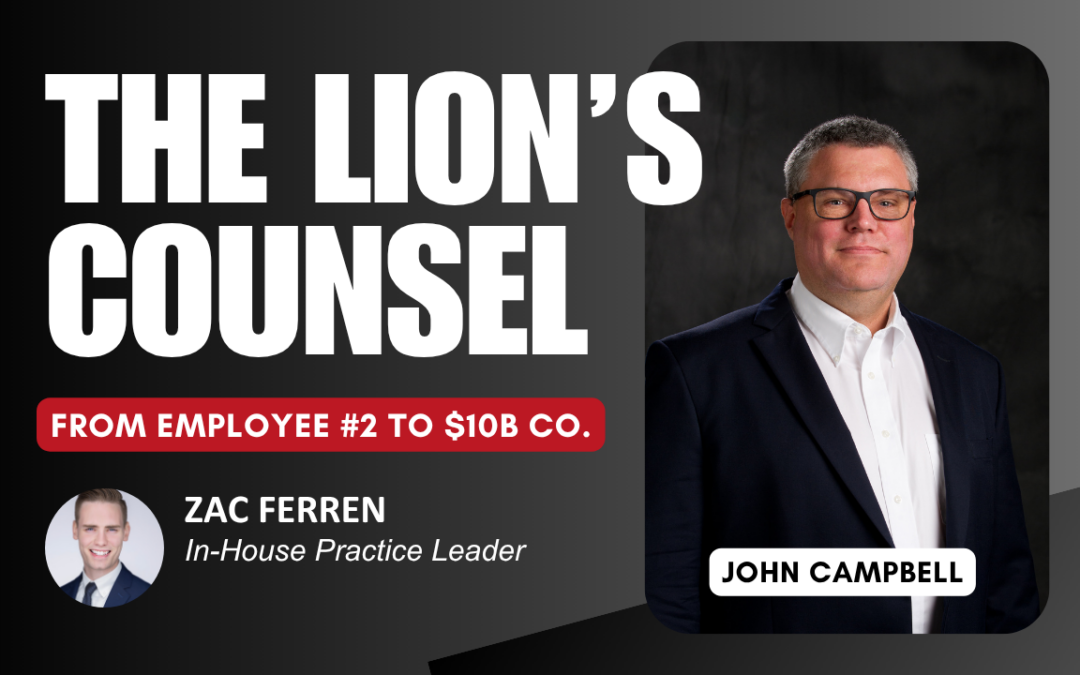
Some general counsel spend a career refining a specialty; John Campbell helped build a company. When he was hired as employee number two at the fiber startup that would become Metronet, the business had a federal loan, a mandate, and almost nothing else. His boss, a long-haul fiber veteran, handed him the keys with a memorable instruction: “Go figure it out.” Two decades later, that startup has grown from an enterprise value of zero to roughly $10 billion.
Based in the Kansas City area and a graduate of the University of Kansas, and Chicago-Kent College of Law, John has spent nearly his entire career in-house, almost all of it working in technology and communications. At Metronet, he was the first attorney, then the builder of a legal team. Along the way, he also oversaw business development and human resources for the company. Today he exclusively serves as Executive Vice President and General Counsel. During his career, he’s learned to negotiate franchises with city governments, develop business cases for expansion, think about indemnification and cash flow in the same breath, and to see the legal function as a business partner rather than a brake.
In this conversation, John talks about scaling a service company without losing its DNA, the “bet the company” moment that put Metronet on the map, what actually separates a good in-house lawyer from a great one, and the mentors who taught him the unwritten rules he now works to pass along.
From Employee Number Two to a $10 Billion Company
Zac: To kick things off, give our readers some context on where you started and how you got to where you are now.
John: From inception, I’ve been in-house, mostly with communications and technology-focused companies. For the majority of my career, I’ve been at Metronet, more than two decades now. I was the second employee hired after the CEO. The company had just been created around a federal loan from the RUS, a branch of the Department of Agriculture, to build badly needed fiber infrastructure in 10 rural communities in Indiana. At the time, the $106 million loan we received was the largest loan given in the history of that broadband loan program.
Cole Hawks, my good friend and boss at the time, was the General Counsel of our parent company, Q-Comm and KDL. He spent most of his time running and building KDL, a long-haul fiber company. At that time, Metronet was going to be a triple-play provider, offering voice, cable television, and high-speed Internet services over fiber infrastructure. Cole didn’t understand much about that industry at all. So, when he hired me, he basically handed me the baton and said, “Go figure it out.”
Cole and Al Cinelli, Q-Comm and Metronet’s founder, believed in a business person first, lawyer second philosophy. I was first introduced to this concept when Cole sat me down while I was working my first major deal at Metronet. I was looking at that deal, saying, “I don’t see how this contract is going to cash flow.” He said, “Look, your job isn’t only to get the indemnification provision right; it’s also to make sure we make money, and that’s how you’re going to be judged.” That was completely eye-opening and frankly scary. I had to really understand, when we were signing up business, what the economic terms were and how they fit into the larger picture of what the company was trying to accomplish. That shaped my thinking and helped me evolve.
To be successful, I learned very quickly that I needed to understand every element of the business and really partner with my internal clients. The best way to do that was to become immersed in our day-to-day operations. Metronet has always been hyper-focused on growth, but in the early days we didn’t have a lot of resources. We had to be extremely adaptable and very, very hands-on. I can remember calling customers personally to address their concerns, sitting down with city leadership in the original 10 communities to work through issues, and negotiating every commercial sales contract like the company’s future depended on it because, at that time, it did.
Zac: I don’t know many GCs who are calling retail customers directly. That’s incredible.
John: To watch the evolution of this company has been pretty amazing. In 20-plus years, we’ve gone from being worth less than zero to an enterprise value approaching $10 billion, from serving 10 rural communities in Indiana to now providing service in 300 communities across 19 states. It’s been an incredible ride to say the least.
Scaling Without Losing the DNA
Zac: What are some of the lessons you learned working on a team that grew Metronet from nothing to $10 billion?
John: There are a lot of them, but the first one that comes to mind is that at different points in your company’s evolution you face distinctly different problems. To grow, you have to stay flexible in your approach and thinking and always be learning. Interestingly, things you dream about as an early-stage company, like growth and scaling to meet market opportunities, can be challenging. As Lion Group continues its success, you’ll face these challenges too, Zac, sooner rather than later, I would expect.
The core dilemma is trying to stay true to who you are and what you do while being aggressive and seizing the opportunity in front of you. You’re a service-based company, you’re experiencing early success, and then you want to scale. How do you make sure that same level of focus on customer service continues as you get bigger? How do you make sure employee 1,000 has the same drive and passion to succeed as the initial team you built the company around? As we created our culture, we wanted to always maintain our focus on customer service, making smart business decisions, and creating a great working environment where people have a chance to grow and feel appreciated. We also worked hard to keep an entrepreneurial drive and sense of urgency alive.
My view is that if you grow just to get bigger, you’ll eventually lose the things that made you successful. You have to ensure you keep your identity at all stages of your development.
A Bet-the-Company Moment: Overbuilding Lexington
Zac: Over your time at Metronet, you’ve seen so many successes on the way to $10 billion. What are some of the proudest moments for you?
John: One of our first real “bet the company” moments was when we decided to overbuild Lexington, Kentucky. Our CEO, John Cinelli, wanted to plant the Metronet flag in the Lexington market for a long time. In addition to my role as General Counsel, I was also responsible for overseeing the selection of new markets and all governmental affairs activities, putting this objective squarely on my plate. Over the course of a year, with a lot of starts and stops, we were able to make it happen despite stiff competition from a nationally known fiber overbuilder. Personally, it represented a challenge that required an intersection of legal skills and the business acumen I had been developing through generous mentoring and real-world experience. Not only was I tasked with negotiating a complex franchise, I also had to cultivate relationships across the city government and community and, most importantly, create a compelling case to our board that the project made economic sense. To watch that project come together and really put us on the map was very gratifying.
Good Lawyer vs. Great Lawyer
Zac: With your perspective over the last 20-plus years, first as the solo in-house lawyer and now leading a team, what do you think makes a really good in-house counsel? And what pushes someone from good to great?
John: A good lawyer is very competent. They understand the law and how it applies to a factual scenario. When we’ve introduced lawyers with no in-house experience to our team, initially they’re great at grasping the legal issues, but struggle being able to explain those issues in the context of the business; that’s the thing that’s so essential. The in-house lawyer who’s exceptional appreciates the business goals and the challenges their internal clients face in meeting those objectives. They can talk in the language of business, articulating things in a way their counterparts can actually understand and quantify. That level of communication only comes with time and experience.
Take a simple agreement: you send it out, you get markups back. Your internal business sponsors have pressure to get the deal done and they want to move forward quickly. You know it’s in the best interest of the business to continue to negotiate certain issues and that adds complexity and time to the overall process. If not navigated correctly, this can create tension. That said, if you can explain why you’re doing what you’re doing, why you’re taking the position you’re taking with sensitivity toward your business counterparts’ objectives, it can alleviate a lot of the tension. Nobody wants to be second-guessed from the cheap seats or receive paternalistic feedback. You’re not there to say no or make their life more difficult. You’re saying, hey, we’re in this boat together, here’s my issue and my challenge, here’s yours, let’s creatively problem-solve and think out of the box. That’s exceptional in-house lawyering in my mind.
To be a great in-house lawyer, above almost anything else: understand the business inside and out and all the factors that impact its financial results both good and bad. In conjunction, learn how to partner with people in your business. Truly appreciating where your internal clients are coming from is achieved only through hands-on experience and really listening.
The Business Behind the Business
Zac: I know you’re passionate about small business. Tell me about that.
John: Doing a ton of M&A work over the years, I’ve had the opportunity to meet a lot of small-company entrepreneurs. Seeing the business through their passion and insight is fascinating and inspiring to me. I love to learn how a business generates cash flow, what the seasonal challenges to cash flow are, what impacts a business both good and bad, and most importantly, figuring out how it can get to the next level.
I have a strategic brain, so when I look at a business, I immediately start reverse-engineering it. For instance, when I think about your business, Zac, I want to know how many referrals do you need in a year to feel good? What are the outside economic factors that affect that, and how do you overcome them? What are the best ways to grow your business in the long term?
Working through those questions is what I find endlessly interesting.
The Mentors Who Made Him, and Giving It Forward
Zac: You’ve mentioned mentors in our previous discussions, and the impact they had on you. Tell me about an impactful mentor, and about why mentoring has become something you’re so passionate about.
John: I’ve had several. Very early in my evolution toward the GC role, I had two mentors, Ted Russell and Tomer Tal, both exceptional in-house lawyers with incredible people skills and business acumen. They instilled in me a sense of how to have a presence when I was talking to senior leadership and board members, how to understand what actually drives a business, how to be an effective communicator which goes well beyond basic legal work. Watching and learning from them taught me how to be savvier in my approach and a partner to the business.
During my time at Metronet, Al Cinelli and Cole Hawks were huge influences. Al was a former GC of Marion Labs. He was a big proponent of Ewing Kauffman, a Kansas City business legend who believed in treating people as “associates” or partners of the business not employees who just collected a paycheck. Al took that knowledge and applied it to Metronet, creating billions in shareholder value in the process. Cole was instrumental in founding KDL out of whole cloth with almost no money or resources and eventually selling it to Windstream years later for $800 million. Both Al and Cole believed deeply in the idea of “business person first, lawyer second.” Al particularly had a million sayings. Two that immediately come to mind are “cash is king”, which I’m sure Zac, is near and dear to your heart, and “don’t ask, don’t get”. Al and Cole taught me to be pragmatic, negotiate hard, and above all to think like a business person.
Zac: What are some of the things you learned from mentors that you never could have learned from a textbook?
John: When you look back on your career and any success you’ve had, you can almost always trace it to the people you met who shared their time and insights with you. These mentors unlocked some of the unwritten rules and schooled you on the way the game is actually played. I benefited enormously from that generosity and sharing. That’s why I’m passionate about mentoring now. I’m fortunately in a position to give back and share those same insights with people who wouldn’t otherwise have access to that information. Like when you walk into a boardroom, there are things nobody is going to tell you but that are absolutely essential to your success. When you go into a complex negotiation, there are things everybody is thinking about, but nobody says out loud. Because I benefited from people who taught me those things, I want to pass that information along as a way of giving back and saying thank you.
Zac: With your passion for mentoring, how can people get connected with you?
John: Shoot me an email or a message. I’m more than happy to share or have a conversation with anyone, and to the extent I can help, that would be great. I look forward to it.
Connect with John Campbell here!
Interested in connecting with John further? Send me a note and I will share his email.