Introduction
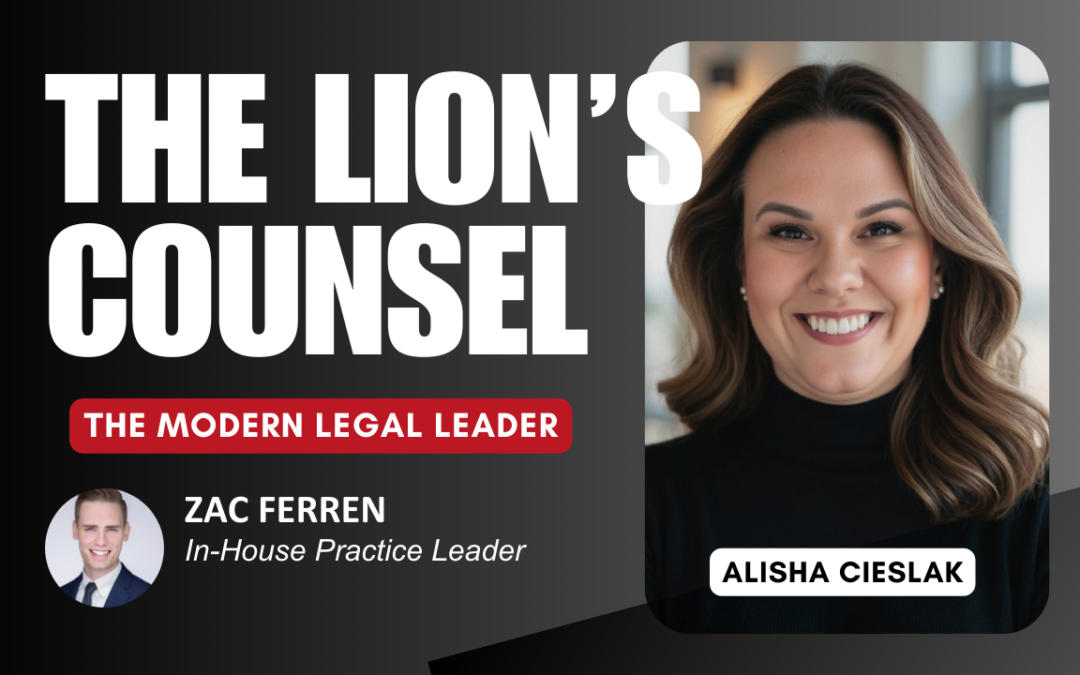
Alisha Cieslak was most recently Chief Legal & Risk Officer at Gordon Food Service, the largest privately-held foodservice distributor in North America. She has built legal departments from scratch more than once, and her work has been recognized nationally, including being named one of the Most Innovative Law Departments in the country in 2020 and receiving a Thomson Reuters award for legal matter management. Her philosophy is straightforward: learn the business, cultivate relationships, and build trust through results to earn a seat at the table.
In this edition of The Lion’s Counsel, Alisha shares how she has built legal functions from the ground up, why she brings her outside counsel on-site to learn the business firsthand, her approach to crisis leadership and enterprise risk management, and how she is thinking about generative AI in the legal department and the enterprise.
Building Legal Departments from Scratch
Zac: You have built legal departments essentially from the ground up—more than once. What initially drew you to those kinds of greenfield opportunities, and what does that process actually look like in practice?
Alisha: I think what drew me to it was the opportunity to shape something from nothing—to actually design how the legal function would operate, what the priorities would be, and how the team would integrate with the rest of the business. When you come into an organization that has never had in-house counsel, there is no playbook. You are writing it yourself.
The process starts with listening. You have to understand the business, the culture, the pain points, and the relationships that already exist before you start building anything. From there, it is about identifying the highest-impact areas where legal can immediately add value—whether that is improving a process, eliminating friction, or increasing speed to market.
One of the things I have learned is that when you are the first General Counsel, the business does not necessarily understand the function and the value that it provides. A new General Counsel cannot assume that they know, and should not just tell them—you must show them through achieving results and desired outcomes. That is how you earn credibility. And I tell new GC’s to be humble. They might come in with a decade of experience at a major firm, but if the people in that building do not yet see why a legal department matters, your resume is not going to convince them. Your approach and your results will.
Zac: When you say you have to earn the right to be strategic, what does that look like day to day?
Alisha: It means being prepared to work harder than you have ever worked, but not always on the legal aspects of the job. The legal aspects are critically important, but helping to guide the organization and decision-makers in the right direction on those legal matters is equally important.
The soft skills matter enormously. Be prepared to listen, to learn, to invest time in relationship-building, to be curious, and to understand that one size does not fit all. The culture and the context you are working within are extremely important as you think about solutions and strategies. Get into the operations, know the products, and understand how they go to market. An outside attorney who comes in with a template approach is not going to be as effective as one who takes the time to understand why this organization operates the way it does and adapts their advice accordingly.
Ideally, you would be positioned to be proactive by being brought into rooms and strategic discussions early. However, when you are the first GC, it is often the case that there is a backlog of legal work that may immediately constrain your time. But that is where you demonstrate reliability and competence, and that is what opens the door to being invited into the bigger conversations. It will feel daunting at first, but focus on the incremental progress you can make.
You may also find that there is some work that cannot be outsourced, even if you need or would like to obtain additional support. Whether it is training a due diligence team because it is the first deal the company has ever done, or prepping internal employees for deposition who have never been involved in litigation before, those are deeply relationship-driven, context-dependent tasks. Outside counsel can feel intimidating to employees, even the most senior leadership. You have to know the people, know the culture, and meet them where they are. That is part of what makes the in-house role so different from outside practice.
Zac: It can also be a pretty isolating role, being the only lawyer in the building. How do you navigate that?
Alisha: It can be a little bit of a lonely job when you are the only one in role. But, as you build your team, you get to create a sub-culture within the broader company culture in terms of how you work together, how you share information, and how you exchange ideas.
So I think it is really important to surround yourself with a trusted network of people outside the company—law firm partners or other GCs you can ask questions of, people you can call and say, is this normal? Am I thinking about this the right way? How are you addressing this problem or challenge? That external network becomes your sounding board, and it becomes invaluable when you are navigating something for the first time. And inside the company, the relationships you build with leadership, with the business units, with your cross-functional partners—those become your support system in a different way. They are the people who help you understand what the organization needs, how to obtain support for your ideas, and how to deliver them effectively.
This is one of the reasons I have found value in inviting our external counsel onsite to visit our facilities. Some General Counsel may feel reluctant to introduce their internal clients to external advisors, for fear of being disintermediated. But the role we play in-house is very different from the role of external counsel. We can talk a bit more about that later on.
The Outside Counsel Partnership Model
Zac: You mentioned your bring outside counsel onsite. That is a novel concept to me. Tell me more about that.
Alisha: The traditional model of outside counsel engagement can feel transactional—you send work out, they do it, and then they send a bill. And there is a place for that in certain matters. But what I have found is that the best outcomes happen when you have strong relationships with your outside partners, and they truly understand your business from the inside.
So what we do is invite our outside counsel to come on-site—typically for a couple of days at a time. We cover their travel and expenses, but their time is donated. And the reason they are willing to do that is that they are invited in as true, valued partners. It is not a vendor relationship—it is a partnership. They hear from our leaders, they walk the facilities, and they meet the people who are making the business decisions. They get to feel the culture, understand the industry context, and build real relationships with the people they are advising.
What that does is fundamentally change the quality of the advice they give us going forward. It is no longer generic counsel based on past experience or a tertiary understanding of the business. It is informed, it is tailored, and it is grounded in a real understanding of how the business operates. And from a cost perspective, it pays for itself many times over because you are reducing the back-and-forth, the misunderstandings, and the rework that comes from having counsel who do not truly know your business. That upfront investment in time—on both sides—makes everything that follows more efficient and more effective.
Zac: How do you think about the different models of outside counsel engagement? You mentioned some alternatives to the traditional approach.
Alisha: I have looked at several alternative service models over the years. In the past, we used Robert Half and had success with a full-time contract attorney to cover a maternity leave. But I have also been drawn to more innovative approaches, with former in-house counsel exploring fractional or contract work. I really like the Paragon Legal model, for example, and the Good Lawyer model in Canada. What I appreciate about those is how they think about staffing and flexibility—they are not just sending you an attorney, they are high-caliber attorneys with in-house experience who can provide immediate value.
Zac: With so many options for law firms and new emerging alternative service providers, what do you look for in the outside partners you choose?
Alisha: First, they have to be willing to invest the time to learn the business, learn how we prefer to be represented, and really understand our needs. Not every firm or attorney is interested in that kind of engagement—some prefer the transactional or one-time engagement model, and that is fine. But the partners I want are the ones who are curious, who are genuinely excited about the brand, and who see value in being part of the broader team – which sometimes includes their competitors.
Technology, Innovation, and Doing More with Less
Zac: You have been at the forefront of bringing technology into the legal department. Tell me about some of those initiatives and what drove them.
Alisha: As long as I can remember, in-house counsel has been thinking about how to do more with less, and there is a huge opportunity to bring efficiency into a legal department through technology.
One of the early wins was introducing an e-discovery technology to cull through massive amounts of electronic data and email in-house. We did this because we understood there is a huge expense associated with data collection, retention, storage, and then going through electronic records with outside law firms and vendors. We asked ourselves: could we cull down the information before it ever goes out and reduce the costs associated with litigation and third-party subpoena responses? And the answer was yes. And what you pay to have that capability pays you dividends every single time you have a matter with a large data production. I was really proud of that work, and our paralegal, Lindsay Kolar, now Assistant Corporate Secretary, won an award through Logikull for the implementation.
We also introduced Diligent Boards for our board and corporate governance, including e-signing capability—really modernizing how the board engaged with information before meetings, and how we obtained signatures and approvals. That was a significant shift for the organization. Before that, we had physical binders being assembled and shipped, and a governance process that was paper-heavy and slow. Digitizing that not only improved efficiency but also strengthened our governance practices by making information more accessible and secure.
And then we implemented Legal Tracker, a legal matter management tool, formerly known as Serengeti. We won a Thomson Reuters award for how we thought about scaling that system as we grew the team. It was one of the first things we introduced, and it laid the foundation for how we track, measure, and manage legal work that is outsourced.
One of the initiatives I am most proud of is around contract lifecycle management. We built a system that took our speed to market on sales contracts from three weeks down to three minutes—and as a result, ninety percent of the company’s sales contracts require little to no legal team intervention. That freed up the legal team to focus on higher-value strategic work instead of being buried in routine contract processing. In 2020, we were nationally recognized as one of the Most Innovative Law Departments in the country for that work—the IC 10 designation. That recognition validated the approach and showed that investing in technology within the legal function was not just operationally smart, it was industry-leading. Aaron Mockridge, our Contract Lifecycle Manager, is the architect behind this extraordinary effort and evolution.
There is still an opportunity to optimize how all of these tools speak to each other and leverage the data that is generated, but in terms of automating processes, reducing cost, reducing friction, and improving lawyer and legal team satisfaction and client service—I think we hit it out of the park.
Zac: Beyond those foundational tools, how are you thinking about generative AI and the next frontier for legal technology?
Alisha: I think about it in three prongs, and this is a framework I have been reinforcing with other General Counsels as we talk about it. First, it is our job to think about how AI will be used by the company broadly, and what governance parameters we want to put around that, because of the risks associated with it, but also the risk of not using it and the loss of opportunity that could occur. Second, we need to think about how AI is being integrated into the company’s products, technology, and other offerings. We have to advise on data privacy issues, biometric considerations, and the evolving regulatory landscape. And third, we need to think about how we incorporate AI into our own legal department tech stack.
There is no shortage of new vendors and market entrants, but we need to be thoughtful about how we introduce that technology—in what application, for what use case—and ensure that we really understand the tech as we purchase it and implement it. As a General Counsel, it can be tempting to delegate this task, but it’s important you understand the potential and promise of generative AI. Ultimately, that technology could be making decisions or taking actions that create risk, and you will be asked to confront the legal issues that are created.
Zac: In my experience, even with our small firm, we use AI, but I have never found the home run option. We have found really solid base hits—like drafting a job description that used to take forty-five minutes now takes three minutes. Have you found any home runs with your implementation, or is it more of the same—consistent base hits adding up?
Alisha: I think it is too early to tell on the home runs, honestly. But what I would say is the base hits are real, and they add up. Gordon Food Service utilizes the Google Suite and has a strategic partnership with Google in its exploration of AI, so every employee has access to AI-assisted capabilities in their word processing, spreadsheets, and presentations. It is used a lot for writing, editing, even photo and video production, and there is a deep research capability built in as well.
On the legal side specifically, Lexis Nexis and Westlaw have both introduced AI capabilities—summaries and accelerated research tools that are genuinely useful. Gordon Food Service was also exploring an AI-enabled tool called Doc Juris, which strikes a nice balance between contract playbooks and fallback provisions without giving up control of the drafting completely.
The home runs will come as the technology matures, but you have to be in the game and building the foundation now.
Crisis Leadership and Enterprise Risk Management
Zac: Let’s talk about leadership in high-stakes moments. When things go sideways—whether it’s a breach, a PR issue, or something nobody saw coming—what does your leadership look like in those situations?
Alisha: I am the unusual person that when there is a crisis, I am running toward it, not away from it. And there will be times in a General Counsel’s career where something happens that nobody has ever experienced before. People will look to you in that moment. And when they look to you, the first piece of advice I would give is this: calm is contagious. Even if you are unsure about the course of action to take, you have to portray calm and be the level head when there is uncertainty, fear, or panic around you.
The ability to lead through a crisis is one of the most important skills a modern General Counsel must have. To successfully navigate these situations, particularly ones you have not encountered before, I have found it useful to first anchor on the company’s values to guide your response, before applying the law. Then, establish a crisis response team of internal experts who are empowered by leadership to act. From there, regular communication with leadership and to the Board will ensure alignment on approach and any key decisions that need to be made.
And for the more foreseeable situations, a good General Counsel will have already thought about what they would do. Having a good enterprise risk management program or a crisis response program—where you have done tabletop exercises, such as disaster recovery rehearsals, makes it a lot easier to navigate the situation when it arrives. You cannot prepare for every possible scenario, because they all will have different contours. But if you have the key decision-makers and considerations mapped out and you know how to activate your vendors, your law firms, and your service providers, you are already halfway there.
Zac: Can you give an example of what that preparedness looks like in practice?
Alisha: Take a cyber breach, for example. Every company, if you have not had one, you will have one—it is just a matter of when. Making sure you have a plan for which cyber response firm you have engaged or on retainer, which law firm has expertise in cyber response, whether you have cyber insurance in place, and what the notification requirements are for the carrier—that is the kind of preparation that separates a manageable incident from a catastrophic one.
And then operationally, how do you engage and work together with your IT leadership and your cybersecurity team? If you do not have an internal cybersecurity team, which outside service provider steps in? All of that should be mapped before the breach happens, not after. You should know who your first call is, who your second call is, what your legal obligations are for notification, and what your communication plan looks like—both internally to your employees and externally to your customers and the public. When you are in the middle of a crisis, minutes matter, and decisions must be made with limited information. If you already know who will be on the team and the general process you will follow, you can focus on the unique nuances of the problem.
And if you find yourself in a moment where you are not fully prepared, and everyone is looking at you, the first step is to clarify with the leadership team who is engaged, who is part of the response team, what the desired outcomes are, and then work toward those outcomes. Preparedness does not mean having every answer—it means being resourceful and having the framework to arrive at the answers quickly.
Zac: How do you think about risk more broadly as General Counsel, beyond just the legal exposure?
Alisha: As lawyers, we are taught to think about legal risk—to mitigate it or manage it. As a General Counsel, your job is to do that while also considering reputational risk, employee retention risk, financial risk, risk to the strategic objectives of the company, and probably twenty other categories of risk on top of those. All of those intersect constantly, and a single event can implicate multiple categories simultaneously.
What I think differentiates me and why I have been effective is that I keep a 360-degree global view of what is happening—in the industry, in the economy, geopolitically, in how technology is evolving—and I provide legal advice within that context. If you are only keeping up with legal trends, you can only see part of the picture. But the best General Counsels go further.
Consider some of the things happening in the world today. We are all navigating through complex societal shifts and evolving regulatory priorities where the legal norms or precedent may not apply. Whether it’s advising leadership on the company’s public voice or preparing for shifts in federal enforcement priorities, a General Counsel must understand the delicate dynamics at play. It is not just about the law—it is about understanding the full environment in which the law operates.
Zac: And for attorneys who aspire to be General Counsel one day, what should they be thinking about?
Alisha: Invest in your business acumen and soft skills as much as your legal expertise. The emotional intelligence, the ability to read a room and understand what people need from you in a given moment—those skills matter just as much as knowing the law, and in some cases, more. A General Counsel who can only analyze legal risk but cannot communicate it in business terms, or doesn’t understand the effect their decisions have on the company’s operations or strategy, is going to meet resistance.
Have a genuine desire to lead people, and that means investing in their development. A highly-effective and cohesive team will amplify your impact. Just as technology improves efficiency, having a capable team will increase the function’s effectiveness. While this may seem like a given, this doesn’t just happen. It is the product of intentional, ongoing cultivation of talent and potential – both inside and outside of the company– and coaching and development of team members. It is a product of meeting people where they are, being honest about their strengths and shortcomings, and co-creating a transparent development plan that will position them to meet their professional goals while fulfilling the company’s needs. And, it is about creating a culture of deep respect, radical candor, and unshakable trust. It also helps if you like each other and can share a few laughs now and again!
Stay current. Keep a global view. Read widely, build your network, and surround yourself with people who challenge your thinking. The world is evolving rapidly—technology, geopolitics, regulatory shifts—and if you are not keeping pace with that evolution, you are falling behind. The best General Counsels I know are relentlessly curious people who never stop learning.
And I would tell aspiring GCs to seek out the hard assignments—the ones where there is no infrastructure, no precedent, and no safety net. That is where you grow the most. Where the work requires you to think strategically and also execute tactically. Where you learn to effect change through influence over positional authority. And where there is no straight line, you must learn to be agile and adapt. This is how you show senior leadership that you are not only a lawyer, but a leader.
Connect with Alisha Cieslak
To learn more about Alisha’s work or connect with her directly, visit her LinkedIn profile.