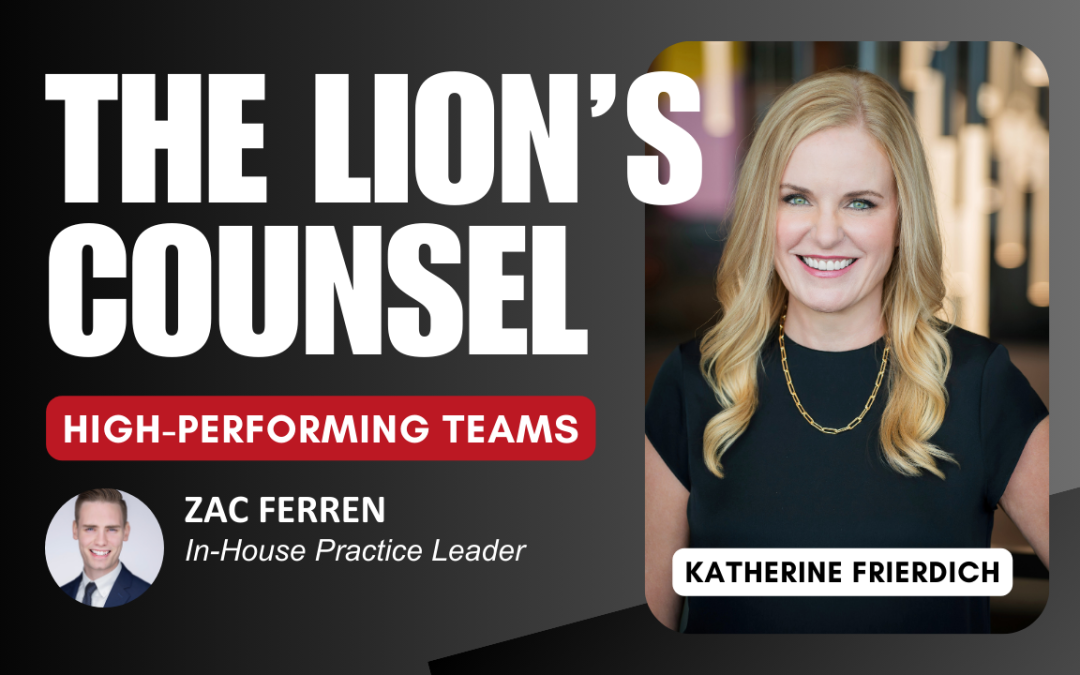
Thanks for taking the time to visit. Below, I interviewed Katherine Frierdich. A Rockstar leader, fantastic attorney, and dear friend to The Lion Group. Katherine is wicked smart and talented at building high-performing teams, and at the same time, being a leader whose team knows that she cares about them personally and wants to invest in and grow their careers. We hope you enjoy!
Katherine Frierdich JD, EMBA grew up surrounded by attorneys; her father, grandfather, and even her brother all practiced law. It was inevitable she’d follow in their footsteps, but the path she chose took her far beyond the family tradition. From tackling complex novel litigation at an AMLAW 100 firm to building legal teams and functions from the ground up in high-pressure corporate and startup environments, she’s made a career out of embracing challenges most would avoid. In this interview, Katherine opens up about the lessons she’s learned along the way, how to measure a legal team’s real impact, why trust is the foundation of leadership, and the strategies that keep costs down without slowing the business.
From Small-Town Roots to Strategic Legal Leadership
Zac: Tell me about your background, your history, and how you got to what you’re doing now.
Katherine: I grew up in a small town. My dad is an attorney, and so was his dad. My brother’s an attorney too. Everyone in the family, except my poor mother, who had to suffer nonstop law talk at Thanksgiving dinner, is an attorney. My dad was my inspiration for pursuing this career.
I went to the University of Illinois because that’s where my whole family went; it was the only school I applied to. For law school, I chose St. Louis University because it’s in the city, and I thought there would be more opportunities, and I was right.
I started my legal career at Bryan Cave, headquartered in St. Louis. Litigation fit my interests and personality, and I worked on all types of cases. Even early on, my growth mindset and people-leadership skills came through. I was the person who would take on unusual, novel cases squarely situated in the gray areas of the law. I surrounded myself with some of the best associates and paralegals, especially for the aspect of litigation I love most: setting winning strategies.
Eventually, the former head of litigation at Bryan Cave recruited me to Centene, where he was launching a Regional General Counsel program. At that time, Centene, despite being a Fortune 100, publicly traded company, didn’t have a comprehensive legal team representing its subsidiary health plans consistently across markets. His program was designed to change that.
When I joined, I had never litigated in healthcare before and didn’t know much about it. Immediately, I was responsible for seven markets, learning Medicaid, Medicare, and the Affordable Care Act, dealing with multiple regulators per market, plus federal regulators and organizations like the National Committee for Quality Assurance. It was baptism by fire, but that fit my approach: as long as I’m busy and learning and not bored, I’m in my element.
During that period, I traveled constantly, covering West Coast health plans and even Mississippi, which is a story in itself. I decided to get my Executive MBA at Washington University’s Olin Business School to better understand the business side and be a stronger partner to the business. That decision was pivotal and helped me secure GC roles later on.
Most recently, I served as GC for a startup undergoing a major business model pivot. I inherited some team members, added some, made some changes, assessed our needs, and focused on building the best team possible with the resources we had. By every single metric, we succeeded year over year, and I’m proud of what we built.
I see my strengths as people leadership, operational excellence, and being a strategic, cross-collaborative partner able to take the 10,000-foot view, no longer stuck in the weeds. I believe general counsels best serve their corporate clients when they operate at that high strategic level, versus head down, mired in the weeds. The latter prevents a cohesive vision across not just the legal function, but also the broader organization, especially complex matrixed ones. That’s not to say that general counsels shouldn’t be prepared to roll up their sleeves to solve problems in the weeds when needed.
Measuring the Impact of a Legal Team
Zac: I’d love to dive into that time at the fast-growth startup and how you measured success around legal team performance and metrics. What are some of the key metrics you think in-house legal teams should track to measure success?
Katherine: The most obvious is contract turnaround time. Businesses often feel like legal slows everything down, so it’s important to track and demonstrate that that’s not the case. We measured how long a contract was in our hands versus in the business owner’s hands versus with a third party.
When we showed the data, like “we only had it for four days out of the three months, it was pending,” it was eye-opening for the business. We also excluded extremely complex contracts or those still in leadership’s due diligence phase from our turnaround metrics, to be fair.
Another key metric came from implementing contract workflows using PADU: Preferred, Acceptable, Discouraged/Disfavored, and Unacceptable language. We built multiple workflows so the business could self-serve on many recurring agreements without legal reviewing every contract. That dramatically reduced the number of contracts our team touched, as well as allowed the business to move faster, stay within the company’s contracting priorities and preferences, and with less errors. Even within the first year of implementation, the difference was striking. Initially, the legal team reviewed every single contract. After training the business units on the workflows, we touched far fewer contracts, while also increasing quality and consistency across documents. Teams knew exactly what termination clauses or other provisions were acceptable, which sped up execution and reduced friction.
I also organized my team into functional “pillars,” each with a lead responsible for succession planning and oversight of their area: Transactions/Corporate Governance, Litigation/Claims/Regulatory and Privacy, and Legal Operations. For contracting and corporate governance, metrics were straightforward. But for litigation, claims, regulatory, and privacy, measurement was trickier.
We looked at litigation demands versus final outcomes, the difference being the value we brought. We implemented a value analysis to make early determinations of cases that made economic and/or reputational sense to litigate, versus reach an early settlement to avoid litigation costs, which add up quickly. We tracked those decisions for disputes resolved early, e.g., nuisance value. We also tracked whether we successfully mitigated reputational risk through crisis communications. We even built a crisis communications playbook to decide when or if to respond, be prepared to issue a response, or communicate proactively. Some of this impact is hard to quantify; if risk is mitigated successfully by us, it’s difficult to assign a number to that success.
Another way we showed value was by assessing outside counsel selection, quality, and cost. Many startups and growth-stage companies default to very expensive, big-name coastal law firms, but for 90% or more of matters, you can find equally skilled counsel for a fraction of the price, often in the Midwest, where I’m from. We tracked cost savings from using regional firms, negotiated discounts off rack rates, and enforced billing guidelines through our matter management platform.
Frankly, I can’t stress enough how important legal operations are for this kind of measurement and cost control. Too many companies, shockingly, have no legal ops function at all. Without it, for example, invoices often go straight to finance without review, meaning no auditing of bills, enforcement of guidelines, or negotiated discounts. My startup team’s Legal Operations functional pillar was a team of three, all of whom had full-time plus schedules of work innovating and building out a world-class function.
The Power of Legal Operations
Zac: What are some metrics that legal operations can look at to measure success? Did you have anything in place for the legal ops function?
Katherine: When I joined, the only thing in place was a contract lifecycle management platform, and it was a good one, so we kept it. But it wasn’t being fully utilized; really, it was just a storage platform. For example, we were still manually tracking renewal dates, even though the system could automatically flag contracts 90 days before renewal.
Entity management existed, but for a startup, the structure was surprisingly complex 18 entities in a highly regulated environment. One of our first big wins was implementing a matter management platform. That allowed invoices from outside counsel to be routed into the system for audit against newly created billing guidelines before payment. When I arrived, invoices just routed straight to finance, no review, no negotiated discounts. That’s a recipe for runaway costs.
We also added a corporate governance platform to improve organizational maturity. With two separate boards and significant board management needs, the platform helped us get everything in order so that, when the company pursued an exit or sought investors, we could demonstrate strong governance and organization.
We tried implementing a ticketing system for intake, but adoption by the business was low. Honestly, we were so capacity-strapped that we didn’t have the bandwidth to drive adoption effectively. That was a lesson in matching tools to both need and available resources.
How CEOs Can Get the Most from Their GC
Zac: From a CEO’s perspective, what’s the best way to manage the effectiveness of the legal department? What are the two or three metrics they should be looking at?
Katherine: First, general counsels should report directly to the CEO. Otherwise, you risk conflicts of interest and situations where important information doesn’t make it to the top, or it isn’t communicated correctly secondhand. The general counsel should also have a direct line to the board, and the board should expect to hear from them.
If I were a CEO, I’d start by asking: Is my GC making an effort to truly understand our business from day one? That means meeting with each business unit to learn their challenges, past experiences with legal, what works, what doesn’t, how they’re structured, their team reporting structure, what’s important to them, their immediate goals, and, crucially, what keeps them up at night. Taking this step within the first 30 days helps general counsels not only learn the business but also understand who the decision-makers are and build the trust that is critical to a successful legal-business working relationship.
Understanding the CEO’s own goals and risk tolerance is essential, too. Every decision that legal makes, has to align with those. Is the CEO aiming for a certain exit strategy? What’s the timeline, one year, three years? What’s their appetite for risk?
Transparency is another big one. Most CEOs just want a clear, succinct answer, not a 50-page memo. That said, I’ve had CEOs who also wanted all the supporting research. Part of the GC’s job is to learn the CEO’s preferred communication style, risk tolerance, and long-term strategy so they can deliver information in the way it’s most useful.
Smarter Outside Counsel Strategies
Zac: How do you balance cost reduction with still delivering high-quality legal support to the business?
Katherine: My team and I talked about this constantly. A lot of legal teams push work to outside counsel and then just manage it like a funnel. Our budget was very small, yet the scope of work was incredibly broad and deep, covering 18 entities and nearly every sub of the healthcare and coverage industry. We had to figure out how to manage that expansive demand without sacrificing quality.
We developed a process: before sending anything to outside counsel, we’d ask ourselves three questions:
- Do we have the tools to handle this internally?
- Do we have the expertise?
- Do we have the capacity?
If the answer to all three was “yes,” we’d handle it ourselves, often using resources like Practical Law or AI tools to help us arrive at the right answers. Outside counsel became more of a sanity check rather than the first stop. If we didn’t solve the problem entirely ourselves, we’d get 90–100% of the way there internally, then ask our outside counsel partners, “Do you see any holes in our analysis? Is there anything we haven’t considered?”
We were very selective about outside counsel. Over time, we built a roster of subject-matter experts who understood our business, knew our risk tolerance, and could deliver quick, concise answers. For example, ERISA issues came up often, but we didn’t have an ERISA expert in-house. After some trial and error (and a few costly and unwanted 30-page memos), we found a “unicorn” in Kansas City who would take our call, talk through issues, and give us an answer in a paragraph.
We didn’t rely on one firm for everything, another mistake I see often. Instead, we matched the right expert to the right matter. The result? Our outside counsel budget was so low that when a new Legal Operations Director joined, she couldn’t believe our spend.
Zac: Were the law firms receptive to that process, or did you get pushback?
Katherine: Some were definitely concerned that their business with us was at risk. They knew our workload and growth goals, so I imagine they were wondering, If they’re not sending the work to us, who are they using?
The key was transparency. I’d tell them, “Nothing happened to cause us to reduce your work. We’ve just changed the way we operate, and we have budget constraints.” We valued the work they did, whether it was a quick ERISA consult or a sanity check on a major initiative, but it simply didn’t generate the volume of fees one would expect to come from such a complex and high-growth environment.
Being a good partner to your outside counsel matters. At the end of every year, we’d meet with our preferred panel to ask: How did we do as a client? How did you do? What could we improve? That two-way conversation helps maintain strong relationships, even if the volume of work changes.
Building the Right In-House Legal Team
Zac: When you’re structuring your pillars and deciding which skill sets to bring in-house, how do you make that decision? In the case of ERISA, you chose not to bring that skill set in-house.
Katherine: ERISA wouldn’t have been a full-time role for us, and ERISA experts are exactly that, specialists. You have to decide which expertise you truly need in-house versus what makes sense to outsource.
When I come into a team, whether I inherit people or not, I start by really getting to know them. I check in often because many people want to take on more or try different things. I’ll ask: Are you happy with what you’re doing? Do you see something we could improve? Is there something you’d like to do that you’re not doing now? Where do you want to be in a year? Five years?
A lot of expertise can be developed internally. Everyone on our team had objectives and KPIs for expanding their knowledge, contributing something new, or fixing a process that needed improvement.
I’m proud that two of our team members, both with JDs but doing mostly paralegal-level work, took and passed the California bar, one of the hardest in the country. We supported them through study time and celebrated their achievement.
Sometimes you uncover hidden talent. One person had been working project to project, and I didn’t have much visibility into her work. After her manager left, I had more interaction with her and more visibility into her work. I discovered she had the ability and interest in contributing to more complex work than the more administrative tasks she had previously been assigned. She was instrumental in building out our complex contract workflows, an ability that I had overlooked. It was a lesson in making sure you know what your people are truly capable of and truly investing in skip-level interactions. So before hiring externally, I always ask: What skills do we already have? What can we grow internally?
For instance, if someone on the team had told me that they were passionate about ERISA, I’d have prioritized and supported that training as their personal objective and KPIs. But no one did.
Tailored KPIs That Drive Growth
Zac: You mentioned setting objectives and KPIs for your team. Were those bespoke per person, or set for the whole team?
Katherine: They were entirely bespoke. I’d work directly with each person to understand their goals, what they wanted to learn, what they weren’t doing yet but wanted to try, and where they wanted their career to lead.
For example, if someone was halfway through paralegal training, their KPI might be to finish the program. One team member prioritized obtaining a Google Analytics professional certificate. The two JDs on our team who earned their law licenses are great examples. It was a huge effort on their part, and the rest of the team supported them, picking up extra work so they could focus on studying. When they passed, we made sure they understood the new responsibilities that came with the license, like providing privilege to the company, and helped them integrate those higher-level skills into their roles.
That culture of supporting each other’s growth is part of why our team stayed together through some very challenging times. In an environment where turnover was happening everywhere else in the organization, we retained our people.
One of my team members once told me she’d never had a boss ask what she wanted to do a year from now, what kind of work she wanted to try, or what her long-term career
goals were. Most lawyers are given their assignments and just expected to execute. I think checking in and getting people invested in the bigger picture and understanding what advancement looks like is critical.
Trust, Technology, and the Role of AI
Zac: Looking ahead at technology and AI, how should legal teams approach these tools?
Katherine: A lot of General Counsels are pretty traditional; they’ve been doing things the same way for 20 or more years. I’ve stepped into situations where my predecessor had people reporting when they were taking a bathroom break. That’s not how I lead.
When I joined Curative, the team was logging every single task they worked on in Monday.com. I told them, “We’re not doing that anymore. We’re all professionals. I trust you to do your job.” My only request was, if you see something, tell me, so we can address it together, and don’t let me be surprised. The worst thing is to be caught off guard in an executive meeting.. That’s how you build trust, by being upfront and transparent. Ending micromanagement was a big step toward a healthier culture.
Technology is important, but timing matters. A startup focused on going to market doesn’t need or prioritize a corporate governance platform right away. But when you’re a startup with 18 entities, two functioning boards, and multiple regulators who expect you to comply with governance rules, you do. The key is knowing when you can justify the cost and at what stage it’s going to deliver real ROI.
Legal tech is evolving at hyperspeed, especially with AI functions in contract lifecycle management and other platforms. Not staying informed on what’s out there is a disservice to your company.
Zac: With so much tech, you could spend years testing tools and never get anything done.
Katherine: Exactly. We were constantly approached by new vendors. There’s no one-size-fits-all solution, so we’d narrow it down to three options, run proofs of concept, and dig in: What are our needs? Can you meet them? It’s a thoughtful selection process, and you have to run the legal department like a business to get it right.
Zac: Did you leverage your legal ops team for that?
Katherine: Absolutely. Ultimately, we pared back the Legal Ops team to one highly motivated and talented Director of Legal Operations/Chief of Staff leader, a legal ops specialist who I previously mentioned took me by surprise when she broke out of her shell and demonstrated her abilities, and a shared legal assistant/privacy role. I don’t think a paralegal-heavy team is as critical as having strong legal ops. That’s where you get efficiency, cost-effectiveness, and measurable value. A strategic GC doesn’t have time to vet tools themselves; that’s why legal ops is essential. Some older-guard GCs still underestimate that role, which is a mistake. And I couldn’t have run legal ops myself.
Zac: Any other thoughts on AI specifically?
Katherine: We worked closely with our CISO to control tool usage, because people will use AI without telling legal or security. We selected an approved platform and used it for a first-pass approach on some problems. But I was clear with the team that we have an ethical duty to verify every AI output. Even with the most skilled prompts, AI still hallucinates. By way of example, and incredibly, we continue to see news of court cases where lawyers cited completely fake cases, which can result in sanctions or worse.
We also had to educate the business that AI doesn’t and can’t replace lawyers and their expert judgment. Sometimes the business would say, “[w]e can just use AI,” and then send us a seemingly spot-on (but not) answer that was clearly generated from ChatGPT or Grok. But AI’s value depends entirely on the input. For high-discretion, high-judgment matters, it’s not a substitute and requires human verification. I think every in-house team is facing that question right now: Why can’t we just use AI to answer legal questions?
One AI solution that I am particularly interested in testing with outside counsel is predictive analysis in litigation practice, which I think could have a tremendous positive impact on in-house litigation management. Many firms have invested in AI tools that can help to predict dispute outcomes, set winning strategies, and enhance decision-making based on analysis of vast datasets, pattern identification, and statistical predictive modeling. These tools can help in-house teams evaluate a case and communicate risk to leadership, prepare more accurate budgets and timelines, and optimize their litigation strategy with the aid of identifying patterns and trends in judicial postures and case outcomes, among other things.
Launching Cadenza: A New Chapter
Zac: Let’s wrap up. Tell me about your newest venture, Cadenzia.
Katherine: Cadenzia is a play on the musical term Cadenza. My daughter is a singer-songwriter, very talented and passionate about music. We also have three boys, all adults in college, who are wonderful, smart, honor-roll students, but they’re not yet passionate about something the way she is. Watching her pursue music has been inspiring, and I wanted the name to honor and reflect that.
I also wanted a name broad enough that, if I bring in legal operations or other functional expertise, it’s not pigeonholed as “Katherine’s GC consulting business.” There are so many ways I can add value to organizations via Cadenzia Consulting.
One pillar is fractional GC work. Whether a company doesn’t have an internal legal function or is in between legal leaders, companies gain from me the strategic thinking and expert management of outside counsel of a General Counsel without the full-time cost to their business. I handle big-picture legal strategy, work directly with leadership teams, and make sure legal issues don’t derail their growth plans. This is perfect for the scenario where businesses need senior-level legal thinking and curated expertise with immediate impact, but aren’t ready to hire someone full-time or are searching for their next legal leader.
I provide legal ops support, serve as an advisor to a sole GC, or manage complex litigation and investigations for companies without the capacity or expertise in-house. I also advise executive teams on what their legal, compliance, or privacy teams should look like now, and how those functions should grow as the business hits key milestones.
What I bring is experience leading teams in a positive, high-performance way, keeping everyone working at the top of their license, and a focus on operational excellence. I’m also a strategic partner who communicates plainly and delivers answers that fit the business’s risk tolerance.
Another interesting function of my consulting business is the “GC in residence” model, in which law firms use my expertise to help them attract and retain clients, mainly startup or early growth stage entities. Having a GC liaison can bridge disconnects between in-house teams and law firms. I also train firms on how in-house departments work and help them to solidify new relationships and learn how to not lose the business.
Hopefully, Cadenzia will be a success, and working for myself will be rewarding in this next chapter of my career. I love mentoring and helping people, so I want to keep doing that, with a little more flexibility.